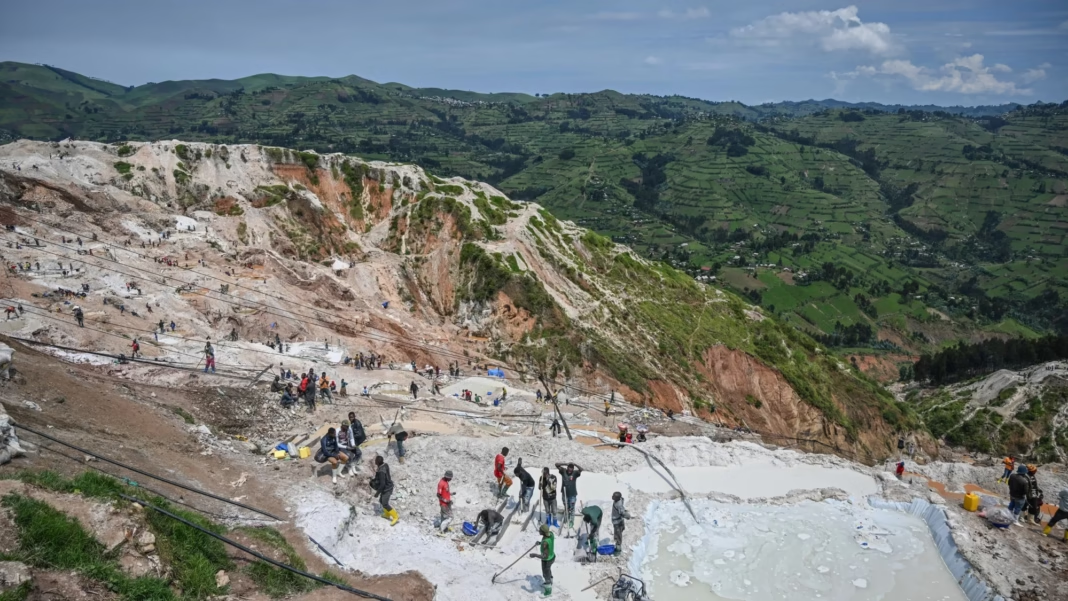

Burundi has exported 1,235 tonnes of critical minerals over the past two weeks, as the government steps up efforts to expand the country’s mining sector and increase the value generated from its natural resources.
The latest shipment, comprising 416 tonnes of rare earth minerals transported in 16 trucks, officially departed on Monday under the supervision of Hassan Kibeya, Burundi’s minister responsible for mining, energy, industry, commerce and tourism.
Speaking during the flag-off ceremony, Kibeya said the pace of exports would continue in early August with planned shipments of 200 tonnes of green quartz and 200 tonnes of amethyst.
The latest consignment follows another shipment made days earlier, when 32 trucks carrying titanium and lithium left the country for export. Together, the two operations have seen Burundi export 1,235 tonnes of minerals in less than two weeks, underscoring the government’s renewed focus on developing the mining sector.
The ministry did not disclose the commercial value of the shipments or identify the companies involved in the exports.
Government officials say China remains the principal destination for Burundi’s mineral exports. Rare earth elements, lithium and titanium are classified as critical minerals because they are widely used in the manufacture of electric vehicle batteries, renewable energy technologies, electronics, aerospace equipment and other advanced industrial applications. Quartz is used in electronics, glass and solar technologies, while amethyst is primarily traded as a gemstone.
Kibeya said the government’s longer-term objective extends beyond increasing export volumes.
“Our ambition is not only to export minerals but also to progressively process them in Burundi in order to create greater added value, generate more employment and strengthen the national economy,” he said.
The government says it hopes the mining sector will attract new investment, support industrialisation and become a larger contributor to economic growth.
However, achieving that goal will likely require significant investment in mineral processing facilities, energy infrastructure and transport networks, as most of Burundi’s minerals are currently exported in raw or semi-processed form.
The expansion comes at a time of growing global competition for supplies of critical minerals, driven by demand from electric vehicle manufacturers, renewable energy projects and high-technology industries. According to the International Energy Agency, demand for minerals such as lithium and rare earth elements is expected to continue rising as countries accelerate the transition to cleaner energy technologies.
While Burundi has increased mining activity in recent years, official data on the sector’s contribution to gross domestic product, export earnings and employment remain limited. The government has identified mining as one of the sectors expected to help diversify the economy beyond traditional exports such as coffee and tea.
Industry observers say the success of Burundi’s mining ambitions will depend not only on sustaining production but also on improving transparency, attracting responsible investment, strengthening environmental oversight and developing domestic processing capacity that allows the country to capture more value from its mineral resources.