

Air travel out of Burundi is rising at its fastest pace in years, and a widening gap in passenger traffic through Nairobi suggests a growing number of travellers are continuing on toward the Middle East.
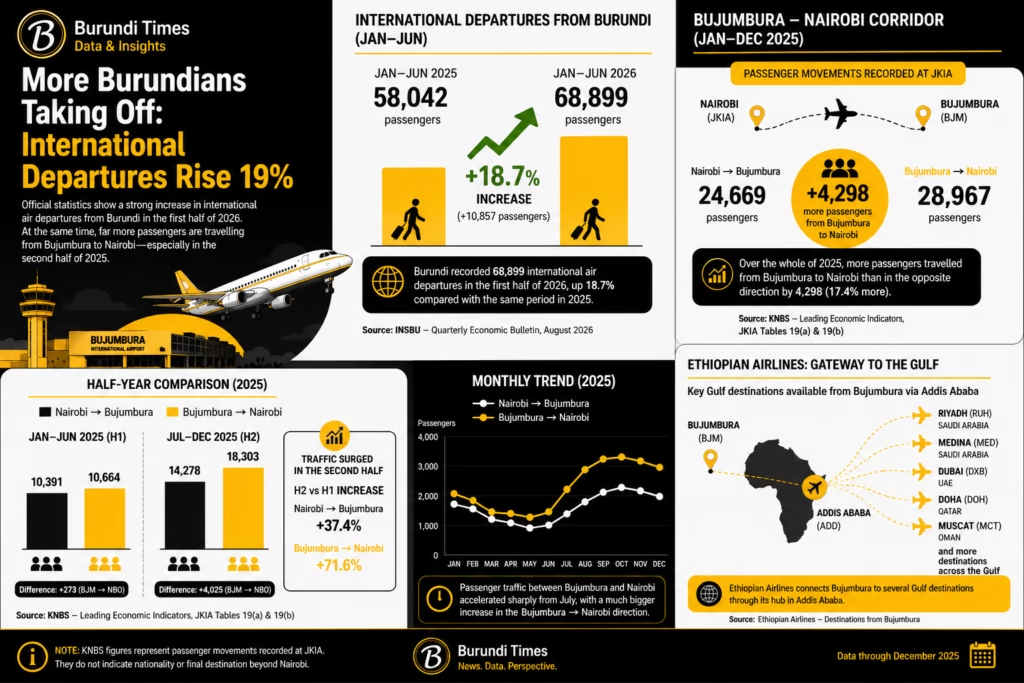
International air departures from Burundi climbed 18.7% in the first half of 2026 to 68,899, up from 58,042 a year earlier, according to figures published by the Institut National de la Statistique du Burundi (INSBU), the national statistics office. Separately, passenger data from Kenya show that traffic between Bujumbura and Nairobi shifted sharply in the second half of 2025, with far more travelers flying out of Burundi’s capital than flying back into it.
Neither dataset says where those passengers ultimately went, how many were Burundian citizens, or why they left. But taken together with Burundi’s expanding labor-recruitment agreements with Saudi Arabia and Qatar, and Ethiopian Airlines’ Gulf routes booked from Bujumbura through Addis Ababa, the numbers point toward a labor-migration story that Burundi’s own statistics cannot yet confirm.
Departures up nearly 11,000
INSBU’s quarterly bulletin, which tracks passenger arrivals and departures at Bujumbura’s international airport, recorded 58,042 international departures between January and June 2025. That rose to 68,899 over the same period in 2026 — an increase of 10,857 passengers.
The bulletin does not break the figures down by nationality, destination or purpose of travel, leaving the central question open: What is driving the increase?
One likely factor is labor migration. Burundi has spent the past several years building formal recruitment channels with Gulf states. On April 14, 2025, the Burundi Minister of Public Service and labor at the time, Vénuste Muyabaga, met with a Qatari delegation led by Qatar’s labor minister, Ali Bin Samikh Al Marri, to discuss implementing a bilateral employment agreement the two countries signed on March 7, 2023, covering the employment of Burundian workers in Qatar. Burundi’s Ministry of Foreign Affairs said the agreement was expected to take effect soon and would give young Burundians access to the Qatari labor market, and officials at the meeting urged domestic recruitment agencies to begin preparing for deployments.
Saudi Arabia’s arrangement is further along. From June 8 to 13, 2026, a Burundian technical committee led by Marie Ancilla Ntakaburimvo, director general in Burundi’s foreign ministry, and including staff from the ministry and Burundi’s embassy in Riyadh traveled to the Saudi capital to review implementation of an existing bilateral recruitment agreement and inspect the living and working conditions of Burundians already there. The two sides flagged recruitment and visa delays, visas were taking 52 days to issue against a target of 20, according to the Burundian embassy in Riyadh along with slow medical screening, language barriers and the absence of a digitised system for tracking recruitment cases. Both governments proposed fixes including digitising the visa process, opening a Saudi diplomatic presence in Bujumbura, and expanding language and cultural training for departing workers.
None of this proves that labor migration caused the 18.7% rise in departures. It does show that sending workers abroad has become an active government priority over the same period departures have grown.
A corridor that tilted sharply in the second half of the year
The Kenya National Bureau of Statistics publishes monthly passenger traffic through Jomo Kenyatta International Airport by port of origin and destination, including a Bujumbura line. The figures for 2025 are below.
| Month | Nairobi → Bujumbura | Bujumbura → Nairobi |
|---|---|---|
| Jan | 1,875 | 1,909 |
| Feb | 1,684 | 1,708 |
| Mar | 1,643 | 1,636 |
| Apr | 1,750 | 1,801 |
| May | 1,671 | 1,697 |
| Jun | 1,768 | 1,913 |
| Jul | 2,488 | 2,752 |
| Aug | 2,461 | 2,979 |
| Sep | 1,568 | 2,989 |
| Oct | 1,830 | 3,347 |
| Nov | 2,959 | 3,229 |
| Dec | 2,972 | 3,007 |
| Total | 24,669 | 28,967 |
Source: Kenya National Bureau of Statistics, Leading Economic Indicators, December 2025, Tables 19a and 19b.
Two patterns stand out. More passengers flew from Bujumbura to Nairobi than the reverse across the full year a gap of 4,298 passengers. And that gap was not evenly distributed, it was negligible in the first half of the year at 273 passengers, before widening to 4,025 in the second half. Roughly 93.6% of the full-year imbalance emerged between July and December alone, with the gap most pronounced from September through November, when the Bujumbura-to-Nairobi leg outnumbered the reverse by 1,400 to 1,700 passengers a month.
Whatever is driving that shift, it began in the second half of 2025 a detail that matters for anyone trying to date it against the timeline of Burundi’s labor agreements or recruitment activity.
The numbers still call for caution. They are airport traffic counts by port, not a census of Burundian citizens, and they include travellers of other nationalities making trips for tourism, business, family visits or education. Kenya’s tables also do not show how many of those passengers continued on from Nairobi rather than ending their trip there. A passenger flying from Bujumbura to Nairobi could have stayed in Kenya, connected onward to Europe, the Middle East or elsewhere in Africa, or been returning from an earlier trip. The 28,967 Bujumbura-to-Nairobi passengers recorded in 2025 cannot be described as 28,967 Gulf-bound Burundians.
A second route through Addis Ababa
Ethiopian Airlines offers a comparable pathway. As of August 2026, the carrier’s website lists Riyadh, Medina and Dubai among its top booked destinations from Bujumbura, alongside dozens of other cities reached through its Addis Ababa hub. The list reflects live booking data rather than a fixed route map.
Ethiopian Airlines does not publish figures showing how many Bujumbura-origin passengers actually transfer through Addis Ababa and continue to Gulf destinations.
Recruitment agreements are advancing, and drawing more scrutiny
Saudi Arabia formally recognises Burundi as a source country for domestic workers. Its Ministry of Human Resources and Social Development caps recruitment costs for domestic workers sourced from Burundi at 7,500 riyals ($2,000), excluding value added tax the same ceiling applied to Sierra Leone, and lower than the ceilings set for the Philippines, Sri Lanka, Bangladesh, Kenya, Uganda and Ethiopia.
Burundi’s government has also tightened oversight of the recruitment industry that connects its labor market to these agreements. On May 15, 2026, Foreign Minister Édouard Bizimana made an unannounced visit to seven recruitment agencies, out of 64 legally registered in the country. The ministry named the seven agencies inspected in its own account of the visit. The ministry said some of the agencies inspected were operating in violation of Burundi’s regulations and that legal measures would follow. Recruitment agencies are one of the mechanisms through which workers move from Burundi’s domestic labor market into overseas employment.
Burundi’s international departures rose sharply in the first half of 2026. The Bujumbura-Nairobi corridor carried a real and widening imbalance through the second half of 2025. Ethiopian Airlines markets a comparable Gulf-bound network through Addis Ababa. And Burundi’s labor agreements with Qatar and Saudi Arabia are moving from signed text toward active implementation and oversight.