
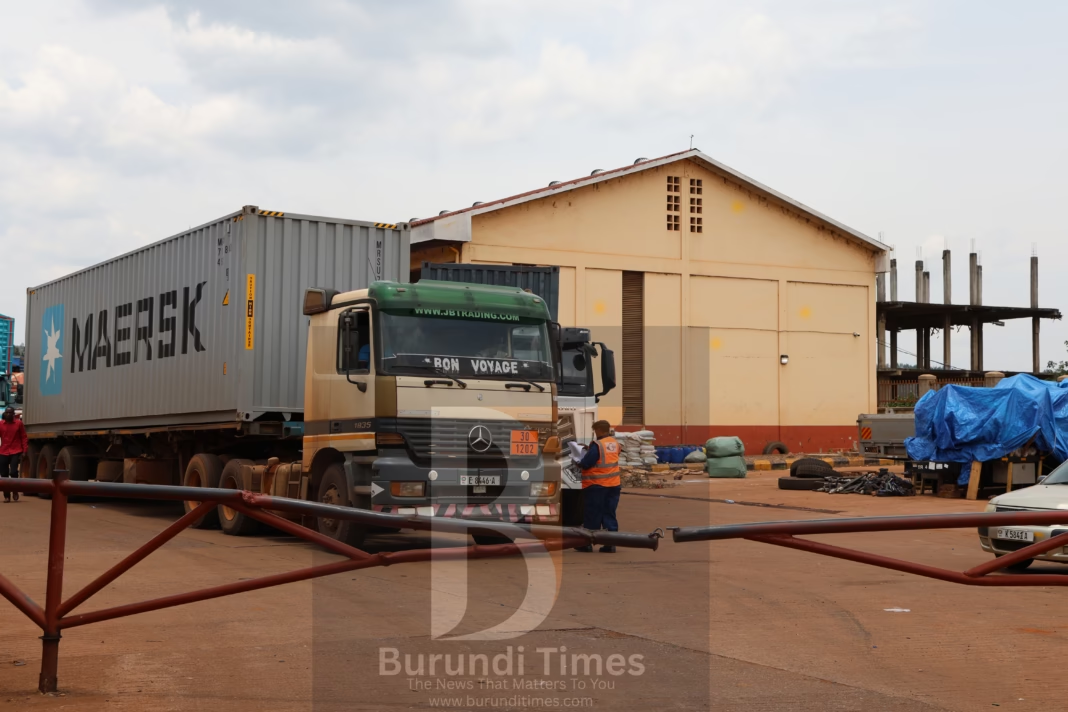

Burundi’s trade gap widened sharply in the early months of 2026, with imports running many times higher than exports each month — a sign of the pressure facing an economy that depends heavily on foreign goods and a narrow base of exportable products.
The Numbers
According to the latest economic bulletin from Burundi’s national statistics agency, INSBU, the country imported goods worth 360 billion Burundi francs (roughly $122 million) in February against exports of just 45.88 billion francs (about $15.6 million), leaving a monthly deficit of 314.11 billion francs (around $106.5 million).
The gap narrowed slightly in March, as imports eased to 312.06 billion francs (about $105.8 million) and exports rose to 71.05 billion francs (roughly $24.1 million). Even so, the country still posted a deficit of 241.02 billion francs (about $81.7 million) for the month.
The imbalance is not new. In 2024, Burundi recorded roughly 444.2 billion francs in domestic exports against 3.1 trillion francs in total imports a full-year deficit of about 2.59 trillion francs, INSBU data show. At the exchange rate prevailing that year, that is equivalent to roughly $170 million in exports against $1.19 billion in imports, for a deficit of about $1.02 billion — though the comparison is approximate, since the franc has weakened further since 2024.
INSBU has attributed the persistent gap to low domestic production of exportable goods, compounded by currency depreciation and rising consumer prices that further tilt the country’s terms of trade.
A Structural Problem
The figures point to a deeper question: how does Burundi finance a persistent import bill when its export base remains so limited?
The International Monetary Fund, in its June 2026 Article IV assessment, put Burundi’s 2025 current-account deficit at 6.6% of GDP, even after accounting for rapid export growth. The Fund linked the shortfall to the country’s reliance on imported food and intermediate goods.
On a trade-balance basis, the IMF estimated a 2025 shortfall equivalent to 10.1% of GDP, with exports of goods and services at just 8.2% of GDP against imports of 22.2%.
The consequences extend well beyond the trade ledger. Burundi’s foreign-exchange reserves stood at roughly $214 million at the end of 2025 enough to cover only 1.6 months of imports. The IMF described the country’s external position as substantially weaker than its economic fundamentals would suggest.
Bright Spots: Gold and Coffee
There are, however, signs of progress on the export side. Stronger coffee and gold sales helped drive 4.2% economic growth in 2025, the IMF said, with export-linked foreign-exchange inflows picking up in the second half of the year and easing some import constraints.
Gold has emerged as a particular bright spot: the IMF estimates gold exports reached $138.9 million in 2025, up sharply from $32.3 million a year earlier, with further gains expected in 2026. Coffee exports also rose substantially over the same period.
The risk is concentration. Leaning heavily on a small number of commodities leaves Burundi’s export earnings exposed to swings in global prices and to production shocks at home.
Policy Response
Burundian authorities have moved to shore up the economy. The IMF said the government adopted a Macroeconomic Stabilization Plan in January 2026, combining fiscal consolidation, tighter monetary policy, foreign-exchange market reforms, and structural measures aimed at productive sectors.
The Fund projects the current-account deficit will narrow to roughly 6% of GDP in 2026, aided by higher gold exports.
Even with export gains, Burundi continues to buy far more from the rest of the world than it sells and the INSBU data show that gap holding even as individual export categories improve.