
The United Kingdom is backing efforts to expand Burundi’s electricity generation and grid, with British development official saying greater access to power could help connect businesses, attract investment and improve essential services such as hospitals and schools.
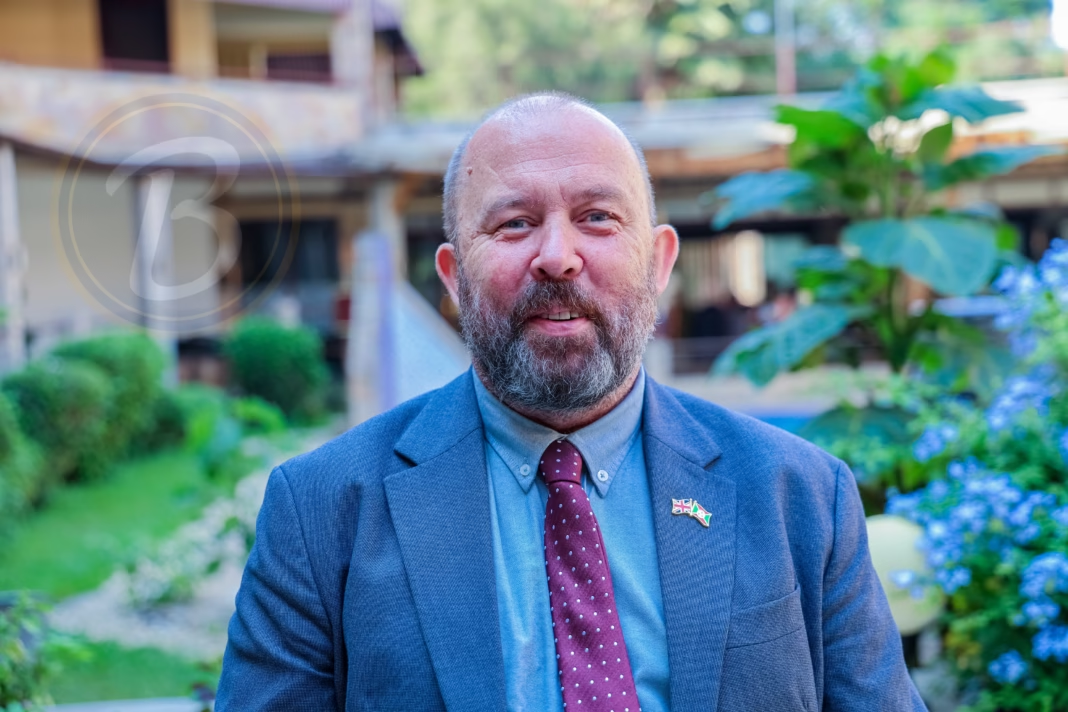
In an exclusive interview with Burundi Times, Billy Stewart, Development Director at the British High Commission in Kigali and Gitega, said the UK is supporting Burundi’s energy sector through several channels, including British International Investment (BII), the UK’s development finance institution.
“The UK is actually one of the top investors in the power sector and the energy sector here in Burundi,” Stewart said.
He said UK-backed investments include support for the Ruzizi III hydropower project, as well as Weza Power and Songa Power, which are exploring hydropower and other renewable energy sources while seeking to expand the electricity grid.
“If we’re able to extend the grid, then that will help not just to connect families and communities, but also connect businesses, improve the ground for investment in Burundi, and also connect vital services like hospitals and schools,” Stewart said.
“So we’re really pleased to be in that position of investment. As I said, it has real potential to help to develop communities, to bring in investment, and to provide stronger services,” he added.
Weza Power and grid expansion
The UK government has identified Weza Power as a major project aimed at expanding electricity access in Burundi. The company was set up under an interim public-private partnership signed between the Burundian government and Anzana Electric Group, Weza Power’s parent, in December 2023, and is backed by a mix of donors alongside the UK, including the U.S. International Development Finance Corporation and the World Bank.
Stewart said BII is supporting Weza Power and Songa Power as they explore new hydropower and other renewable energy sources, and as they work to expand the electricity grid so that access can increase across the country over the coming years.
Weza Power’s initial pilot is targeting more than 40,000 new household and business connections, with the company’s longer-term plan aiming to serve up to 9 million Burundians over the next seven years by rehabilitating and expanding the national distribution network alongside the state utility, REGIDESO.
For businesses, limited and unreliable power supply has long been identified as a constraint on economic activity and investment in Burundi, and Stewart said extending the grid could help address that by connecting businesses as well as households.
Burundi has one of the lowest electrification rates in the world. A decade ago, only about 4% of the population had power; by the early 2020s that had risen to roughly 10–12%, and reporting on the country’s energy sector this year put national access at around a quarter of the population following the commissioning of the Jiji and Mulembwe hydropower plants, still well below the roughly 51% average for Sub-Saharan Africa. The gap is starkest in rural areas, where access has hovered at around 2%.
The government’s Universal Access Program, launched in 2023, targets universal electrification by 2030, with donors including the World Bank, the UK, the U.S. and the EU backing different pieces of the effort from grid reinforcement to the private-sector distribution push led by Weza Power.
The UK is also supporting the Ruzizi III hydropower project through BII. Ruzizi III is a regional, run-of-river plant on the Ruzizi River, developed as a public-private partnership between the governments of Burundi, Rwanda and the Democratic Republic of Congo. Once complete, it is expected to add 206 megawatts of generation capacity — more than double the combined output of the existing Ruzizi I and II plants (29.8 MW and 43.8 MW respectively) with output shared among the three countries and fed into the East African Power Pool.
Stewart said the project would increase power generation once completed. Construction is reported to be under way, though progress has at times been slowed by political friction among the partner states. The project forms part of wider efforts to address electricity shortages in the Great Lakes region and expand access to renewable energy.
Climate and energy
Stewart said the UK’s energy cooperation with Burundi forms part of a broader development partnership that also includes climate-related work.
“We also have a partnership with the Burundian Meteorological Office and the UK Meteorological Office on climate forecasting, which will help us to better understand the climate risks coming up and better be able to prepare for them,” he said.
He cited the threat of El Niño and other climate-related risks as reasons for strengthening forecasting and preparedness, saying improved climate information could help Burundi and humanitarian partners get ahead of potential disasters and respond to emerging needs.
The comments come as Burundi continues to seek greater investment in energy infrastructure, with the government targeting expanded generation and wider access to power as part of its broader development agenda. For the UK, Stewart said, the objective is not only to increase electricity connections but also to create conditions in which businesses can operate, investment can grow and essential public services can benefit from more reliable power.