
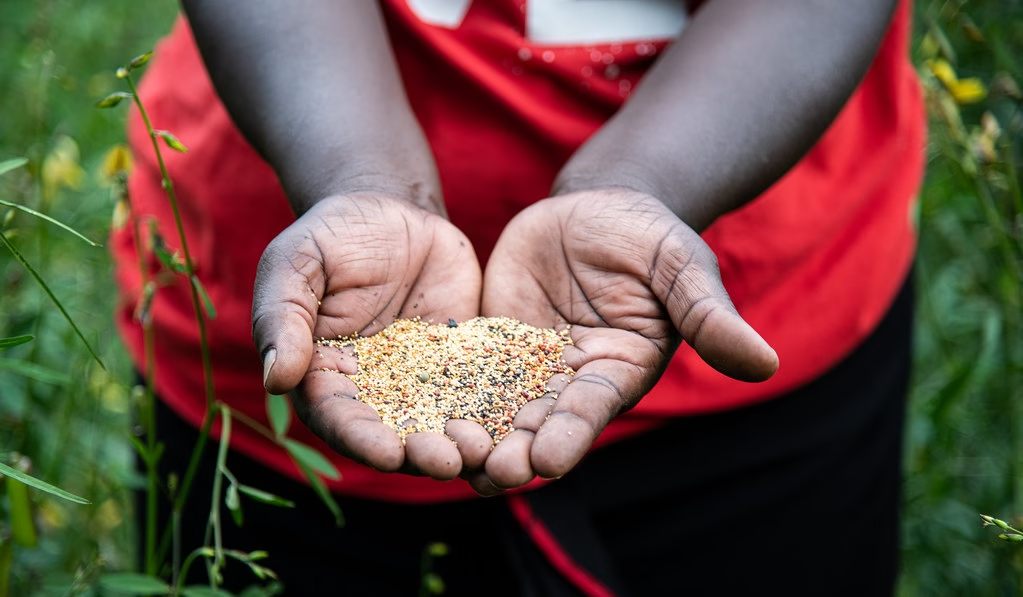

Tanzania has urged the East African Community (EAC) to overhaul its proposed regional seed law, warning that efforts to create a common seed market could undermine smallholder farmers, indigenous seed varieties and traditional systems for conserving and exchanging seed.
In submissions on the proposed EAC Seed and Plant Varieties Bill, 2025, Tanzanian stakeholders broadly support the harmonisation of seed testing, certification, variety evaluation and regional trade, but say the bill gives insufficient recognition to Farmer Managed Seed Systems, community-based systems through which farmers save, select, conserve, exchange and trade seed.
They want binding provisions to protect these systems and propose renaming the legislation the EAC Seed, Plant Varieties and Plant Genetic Resources Bill, 2025, arguing that its current scope does not adequately address genetic resources, traditional knowledge and farmers’ contributions to seed conservation and development.
At the center of their concerns is a warning that a regulatory framework designed primarily around commercial seed could impose requirements unsuitable for farmer varieties and restrict long-standing community practices.
Tanzania also wants farmer varieties, non-commercial varieties and smallholder farmers explicitly recognized in the regional law. It argues that farmer varieties should not face the same commercial registration requirements as varieties developed by commercial breeders. In particular, conventional distinctness, uniformity and stability testing could be costly and difficult to apply to varieties developed, selected and maintained by farming communities.
The stakeholders propose alternative mechanisms for communities that want their varieties formally released or registered, to be developed in consultation with smallholder farmers, pastoralists and other relevant communities. They also want the bill to make clear that the sale and exchange of non-commercial varieties through farmer-managed seed systems within a partner state should not be prohibited.
The stakeholders say recognizing these systems is not simply about protecting tradition. Farmer-managed seed systems are important for maintaining seed diversity and can contribute to food security, nutrition and agricultural resilience.
Irene Liborious of the Eastern and Southern Africa Small Scale Farmers Forum said the regional framework must recognise that smallholder farmers are not simply seed users but have, for generations, played a central role in conserving, developing and sharing seed diversity.
“Farmers must be recognised as custodians and developers of seed, not simply as consumers of commercially produced varieties. Harmonisation should strengthen regional seed systems without taking away farmers’ rights to save, use, exchange and develop their own seed,” Liborious said.
She added that recognizing Farmer Managed Seed Systems in the regional legislation would help protect indigenous and farmer varieties while strengthening biodiversity, food security and farmers’ resilience to climate change.
Apollo Chamwela, a smallholder farmer from Morogoro and a member of MVIWATA a swahili acronym for National Network of Small-Scale Farmers Groups in Tanzania, said many farming communities rely on locally adapted seed because it is affordable, resilient and passed down through generations.
“Our seed is our heritage and our insurance against climate shocks and geopolitics. If regional laws make it difficult for farmers to save and exchange their own seed, they will weaken the systems that have sustained our communities for decades and undermine our food sovereignty,” Chamwela said.
He urged the East African Legislative Assembly to ensure the bill protects both formal and farmer-managed seed systems, rather than treating them as competing systems.
Tanzania also raises concerns over the relationship between plant breeders’ rights and the genetic resources and traditional knowledge that may underpin new commercial varieties. The bill seeks to establish a regional framework for breeders’ rights and a Community Register. Tanzania wants stronger safeguards to prevent indigenous genetic resources or traditional knowledge from being appropriated without the consent or participation of the communities that have conserved them.
It proposes that applications for plant breeders’ rights disclose the origin of plant genetic resources used to develop a variety, associated traditional knowledge, details of lawful access and applicable benefit-sharing arrangements. The proposed regional register should similarly disclose the origin of genetic resources and document free, prior and informed consent from communities that provided access, together with benefit-sharing agreements where resources were obtained from farming communities.
The stakeholders further want the bill to clarify that granting breeders’ rights does not amount to ownership of plant genetic resources, genetic material or associated traditional knowledge. Nor, they argue, should breeders’ rights extinguish existing farmers’ rights or benefit-sharing obligations arising from the use of genetic resources.
Tanzania is proposing an entirely new section covering plant genetic resources, associated traditional knowledge, and access and benefit-sharing. The proposed provisions would promote the conservation and sustainable use of plant genetic resources, including local, indigenous and farmers’ varieties, while supporting community seed banks, gene banks, research, breeding and capacity building.
Access to genetic resources and associated traditional knowledge would require prior informed consent and mutually agreed terms, with the rights and interests of farmers and indigenous and local communities protected. Where genetic resources or traditional knowledge are used, benefits should be shared fairly and equitably. Proposed benefits include royalties, research partnerships, technology transfer, training, capacity building and support for conservation and community development.
The stakeholders also want the law to recognise farmers and local communities as contributors to the conservation, development, maintenance and sustainable use of plant genetic resources. Partner states would be encouraged to support farmers’ and local varieties, community seed systems and seed banks, while promoting farmers’ participation in plant breeding and variety development. The approach would give farmers a more formal role as custodians and developers of agricultural genetic resources, rather than treating them primarily as consumers of commercially produced seed.
Tanzania supports the creation of a Community Plant Variety Catalogue but wants additional safeguards. It proposes that the catalogue identify the partner states where each variety has been released and the agro-ecological conditions under which it was approved. The stakeholders also call for protection against the extraction or misuse of information relating to national and regional varieties, including safeguards consistent with data governance, digital rights and access-and-benefit-sharing requirements. They raise particular concerns about the potential misuse of seed-related information and genetic material in developing and marketing gene-edited or genetically modified varieties.
On seed quality control, Tanzania is seeking clearer rules for recognizing test results across partner states. Its submission calls for a regional accreditation framework, periodic audits of designated seed-testing laboratories and at least one accredited seed-testing laboratory in each partner state. It also wants the EAC Council to establish common seed-testing standards. At the same time, Tanzania wants receiving countries to retain the ability to undertake necessary quality-control measures when certified seed moves across borders.
The bill’s broader objective is to facilitate regional trade in certified seed and approved varieties through common approaches to testing, inspection, certification and variety evaluation. But the stakeholders argue that regional harmonisation must not come at the expense of farmers’ rights, indigenous seed diversity, biodiversity and food sovereignty.
They acknowledge that a common regulatory system could strengthen quality control, facilitate cross-border trade and support innovation in plant breeding. But they insist these gains must be balanced against the reality that many smallholder farmers depend on farm-saved and informally exchanged seed rather than commercially certified varieties.
Their proposed amendments therefore seek to expand the bill beyond a framework centered largely on commercial seed regulation and plant breeders’ rights, to one that also protects plant genetic resources, traditional knowledge and farmer-managed seed systems. Their central message is that regional harmonization should not impose a single model of seed production. The EAC’s emerging seed rules, they argue, should accommodate both commercial seed markets and the farmer-managed systems that have long sustained seed diversity, conservation and food production across East Africa.
Across the region, the Eastern and Southern Africa Small Scale Farmers Forum (ESAFF) mobilised and coordinated smallholder farmers in all EAC partner states to participate in the ongoing public consultations on the EAC Seed and Plant Varieties Bill, 2025. Through national farmer networks and regional coordination, the organisation supported farmers to review the bill, develop country-specific submissions and present recommendations during consultations held Aug. 27-28.
Emmanuel Justine of ESAFF said the process was intended to ensure that smallholder farmers’ perspectives, priorities and lived experiences are meaningfully reflected in the final regional legislation.