
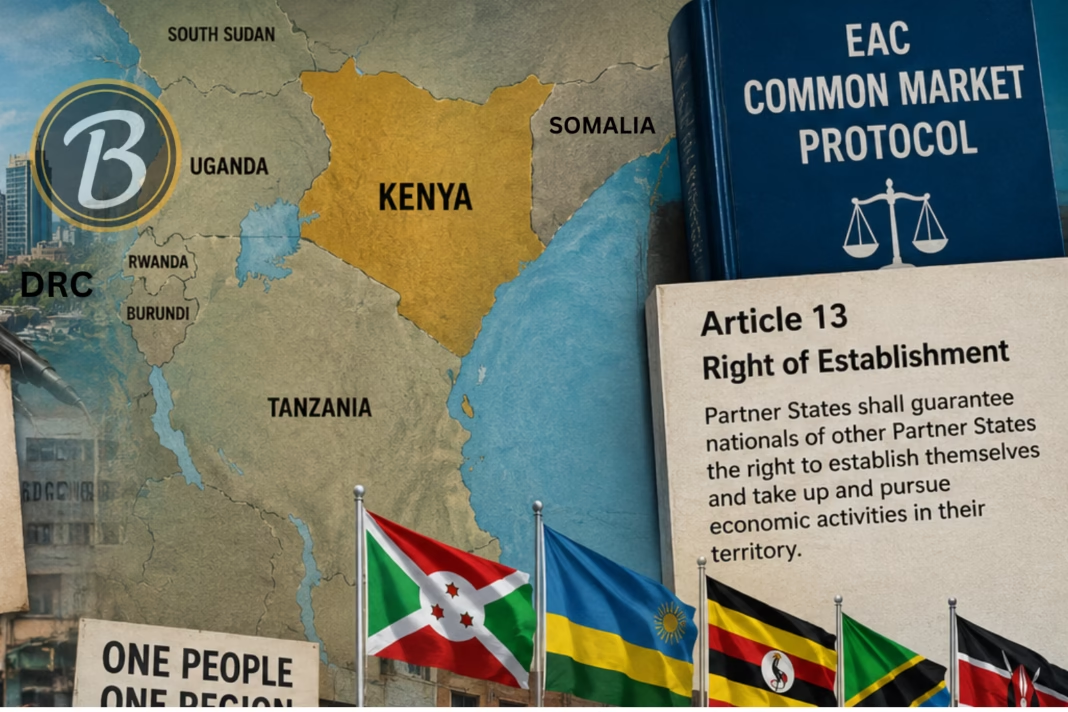

President William Ruto’s order to shut down foreign-run small businesses in Kenya is raising questions about the future of the East African Community’s Common Market, pitting a domestic push to protect local traders against one of the region’s core integration commitments.
Ruto said Wednesday that Kenya would begin enforcing the crackdown Monday, targeting foreigners in hawking and small-scale retail.
“From next week, all traders doing those small businesses should close them,” Ruto told micro, small and medium enterprise traders at State House in Nairobi. He said Kenya had worked to build investor confidence, but not to attract hawkers.
“We have not built investor confidence so that hawkers can come to Kenya,” he said. “The investor confidence we have built is for investors to come to Kenya, not hawkers and traders. People should not confuse us.”
Ruto directed Trade Cabinet Secretary Lee Kinyanjui and National Assembly Majority Leader Kimani Ichung’wah to fast-track legislation reserving certain businesses for Kenyan citizens, saying the government would act administratively rather than wait for Parliament.
The order carries particular weight for nationals of Burundi, Rwanda, Uganda and Tanzania, whose citizens are covered by the EAC’s Common Market framework.
Complaints about Burundians preceded the order
The announcement follows months of rising complaints in Kenya about foreign nationals competing for low-income jobs and informal business.
In June, Dagoretti North MP Beatrice Elachi accused some employers of hiring Burundian construction workers over Kenyans because they would work for lower pay. “I can see some people have taken up many jobs in the construction industry. I am about to disrupt that situation and tell them, ‘You cannot come to Kenya and take jobs at 400 shillings a day when Kenyans are paid 700 shillings and above.’ That cannot continue,” she said.
Elachi also accused some foreign nationals of working without proper immigration documents and said she would push the issue in Parliament if the government did not act. She extended her complaint to informal trade, saying Burundians selling coffee and groundnuts were taking opportunities that should go to Kenyans.
Tensions escalated in July after a video showed a Kenyan man confronting a Burundian tea and mandazi vendor in Nairobi, accusing him of taking Kenyan jobs and business. The incident drew condemnation, and Kenyan officials moved to reassure Burundian nationals of their safety.
Against that backdrop, Ruto’s order shifts what had been mostly a political and social dispute into formal government policy.
What the Common Market protocol requires
Kenya’s regional commitments go well beyond allowing East Africans to cross borders. The EAC Common Market Protocol, in force since 2010, guarantees free movement of people, workers, services and capital, along with rights of establishment and residence, with the goal of merging national markets into one regional economic space.
Article 13 of the protocol the right of establishment is most directly at issue. It requires partner states to guarantee that right to other partner states’ nationals without discrimination based on nationality, allowing them to “take up and pursue economic activities as a self-employed person” and to “set up and manage economic undertakings” in another partner state. Article 13(5) bars partner states from imposing new restrictions on establishment except where the protocol permits it.
That language poses a legal problem for a policy excluding people from small businesses based on citizenship alone. The EAC has said its Common Market rules let citizens of partner states start businesses elsewhere in the region under host-country law, and has said partner states must remove nationality-based restrictions.
The protocol does allow limits on establishment for public policy, public security or public health, provided the restricting state notifies other partner states. Protecting local traders from competition is not among the grounds the protocol lists for such restrictions which is why Ruto’s directive could test the Common Market.
Kenya would not be the first
Tanzania adopted a similar measure in July 2025: the Business Licensing (Prohibition of Business Activities for Non-Citizens) Order, barring non-citizens — including other EAC nationals — from 15 categories of business, among them retail trade, mobile-money services and salons.
That order is now before the East African Court of Justice. In Reference No. 31 of 2025, the applicant argues the prohibition violates the EAC Treaty, the Common Market Protocol and the right of establishment. Reference No. 37 of 2025 makes a similar challenge on free movement of services, capital and establishment; the court’s record includes citizens of Burundi, Kenya, Rwanda, Uganda, South Sudan, Congo and Somalia among those potentially affected. Neither case has been decided.
Tanzania’s experience is a warning for Kenya: Once governments reserve economic activities for their own citizens, the dispute quickly moves from domestic politics into the legal machinery of East African integration.
A possible regional pattern
Ruto’s order could extend a trend Tanzania began, governments reserving low-capital business for their own citizens while still promoting the Common Market regionally, a contradiction the EAC has flagged before.
After Tanzania’s 2025 restrictions, the EAC Secretariat said in a statement that partner states had committed to removing barriers to trade, services and investment, and to avoiding unilateral measures that hinder free movement and establishment rights across the region. That warning could resurface if Kenya applies its restrictions to EAC nationals.
Enforcement vs. exclusion
Kenya has a narrower path available. The Common Market Protocol does not exempt foreign nationals from national law, EAC citizens must still meet host-country licensing, tax and health requirements. Kenya could lawfully enforce immigration and licensing rules against traders operating illegally.
The harder question is whether banning an entire economic activity based on nationality is compatible with the regional right of establishment. A Burundian trading without a permit is a different legal matter than one who has met Kenyan and EAC requirements but is ordered to stop solely for not holding Kenyan citizenship. The scenario Article 13 was written to prevent.
A test for integration
The timing matters. The EAC says the Common Market was meant to be fully implemented by 2015, a deadline it missed, though implementation has continued. In February, the EAC convened a high-level dialogue on barriers to intra-regional trade, with the Secretariat saying most remaining problems are operational rather than legal.
Ruto’s order sharpens that challenge. If Kenya proceeds with a nationality-based restriction, the EAC faces a central question: Can a Common Market survive if partner states can each decide their neighbors’ citizens are barred from parts of their economy?
For Burundi, the stakes are immediate, its nationals are already visible in Kenya’s informal economy and have been singled out in recent political debate over jobs and trade. For Kenya, the domestic case is simple, scarce economic opportunities should go to Kenyans first. For the EAC, the case is more complicated, since the regional project exists specifically to let partner-state citizens cross borders into a larger economic space.
Ruto’s government must now reconcile a domestic promise to protect Kenyan entrepreneurs with commitments made under the EAC Common Market Protocol. The outcome could shape whether East Africa’s Common Market becomes a functioning regional economy or remains, in practice, a set of national markets guarded by national borders.