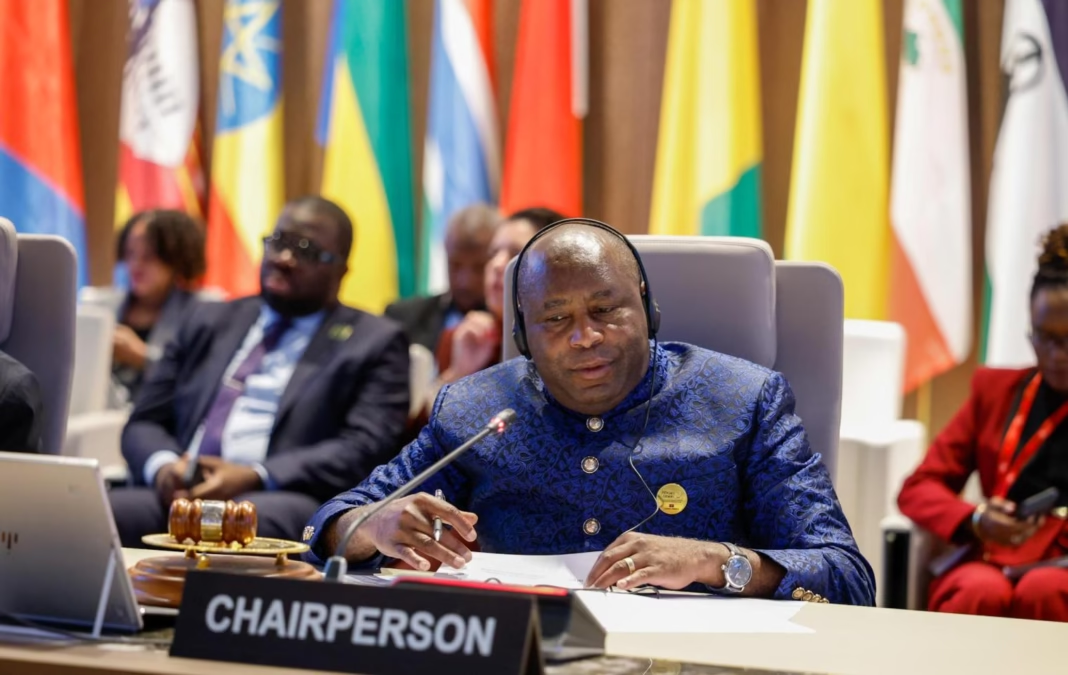

Burundi’s president and African Union chairperson, Évariste Ndayishimiye, told fellow African leaders Sunday that political exclusion, weak institutions and social injustice are what turn grievances into wars an argument he drew from his own history as a former rebel, even as rights groups continue to question the state of political competition back home.
Addressing the opening of the AU’s 21st Extraordinary Session in Luanda, Ndayishimiye said the continent’s conflicts typically grow out of problems governments fail to confront early.
“Conflicts are rooted in governance deficits, weak institutions, political exclusion, inequality or social injustice, and a lack of opportunities for citizens, particularly young people,” he said.
The remarks land against a difficult backdrop at home. Burundi held legislative and local elections in 2025 in which the ruling CNDD-FDD took roughly 96.5% of the vote and every seat in the National Assembly, according to Human Rights Watch, which said the vote unfolded amid severe restrictions on opposition parties, free expression and political participation.
Amnesty International likewise documented curbs on opposition activity around the elections, and Freedom House’s 2026 assessment rates Burundi “Not Free,” citing intimidation, threats and arbitrary detention of opposition supporters during the campaign.
Burundi’s government has rejected accusations that it is suppressing political opponents, and has continued to frame its approach as one of stability, dialogue and national unity.
Ndayishimiye, for his part, told delegates that Burundi has built a permanent forum for dialogue among political parties and that he meets regularly with political and civil-society leaders ahead of elections. With the country’s 2027 presidential vote now on the horizon, he said, there had been “no signs of weakness” because political actors were working together.
“Today, we can say with pride and humility: the inter-ethnic divisions that have profoundly marked our history belong to the past,” he said. “They no longer define Burundi nor determine the future of its children.”
From rebel to president
The speech’s most politically loaded passage was personal. Ndayishimiye, a former senior figure in the CNDD-FDD rebellion before it became Burundi’s ruling party in 2005, told delegates he took up arms against the state during Burundi’s civil war because of what he described as widespread injustice and abuses by security forces.
“My experience is not far removed from David’s,” he said, invoking a biblical reference used earlier in his address. “I am among those who took up arms against the power of the State, not for mere pleasure but out of necessity to redress the multifaceted injustices that plagued my country.”
He argued the war might have been avoided had grievances been addressed sooner, “If corrective measures had been taken in time, the war would not have occurred” and framed conflict prevention across the continent in the same terms, “prevention therefore consists of addressing the root causes rather than the immediate manifestations of crises.”
He also tied poverty and unequal access to resources to instability, arguing that desperation makes people easier to mobilize for violence.
Arusha as the model
Ndayishimiye pointed to the 2000 Arusha Agreement for Peace and Reconciliation as the foundation of Burundi’s post-war settlement, crediting it with putting reconciliation, inclusion and political representation at the center of rebuilding the country.
“Reconciliation is not about erasing history, but about facing it, learning from it and building a different future together,” he said.
He said Burundi is now sharing that experience elsewhere on the continent, citing its peacekeeping and stabilization contributions in Somalia, the Democratic Republic of Congo, the Central African Republic and beyond. The AU has increasingly cast Burundi in that role since Ndayishimiye took the rotating chairmanship for 2026 from Angola’s João Lourenço at the bloc’s February summit in Addis Ababa.
Sudan and eastern Congo test the system
Beyond Burundi, Ndayishimiye used the platform to fault Africa’s broader record on conflict prevention, arguing the continent already has the institutions it needs but keeps acting only after crises spiral.
“Africa does not lack peace and security mechanisms,” he said, ticking off the AU Peace and Security Council, the Continental Early Warning System, the Panel of the Wise, the African Standby Force and the Peace Fund. “Despite the existence of these mechanisms, we continue to chase after a fait accompli.”
He pointed to Sudan’s collapse despite clear warning signs and to fighting in eastern Congo, which has persisted through multiple agreements and peace processes. The summit itself was called to press for reforms to the continent’s peace and security architecture, stronger early warning, better follow-through on AU decisions, and sustainable financing for peace operations putting Ndayishimiye’s critique in step with the gathering’s official agenda.
A call for African financing
Ndayishimiye also argued Africa cannot claim real ownership of its peace and security agenda while depending so heavily on outside funding.
“There will be no lasting African ownership of our peace and security agenda without predictable, sustainable and flexible African funding,” he said, calling for deeper capitalization of the AU Peace Fund and closer coordination among the AU, regional blocs, member states and the U.N.
The AU Chair called on leaders to move from diagnosing crises to acting on early warning. “This meeting must therefore be a moment of decision, not of observation.”