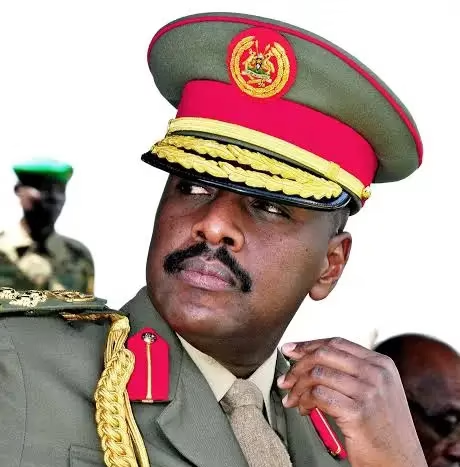

Ugandan citizens have the right to demand the name and badge number of any officer arresting them, and can resist the arrest if the officer refuses to provide it, Uganda’s Chief of Defence Forces Gen. Muhoozi Kainerugaba said Friday.
Kainerugaba made the claim in a post on X announcing a new requirement for police officers to visibly display their identity on their uniforms. “From today and forever more ALL Ugandan Police Officers will wear their name tags on their right chest pocket,” he said. “They must also wear their police badge and number on their left chest pocket.”
The most consequential part of the post concerned what happens if they don’t. “All Ugandan citizens have the right to demand the name and badge number of any arresting officer,” Kainerugaba said. “If they do not respond, you have the right to resist arrest.”
Kainerugaba did not cite a legal basis for the claimed right to resist arrest, nor explain how the directive squares with Uganda’s existing arrest laws. A statement from a senior security official does not by itself create a new statutory right, and the announcement came from Kainerugaba’s personal social media account rather than a formal Uganda Police Force communication leaving the legal weight of the directive, and how it would be enforced, an open question for police authorities and legal institutions.
New uniform requirement
Under the directive, officers would wear name tags on the right chest pocket and their badge and ID number on the left. In principle, that could make it easier for civilians to identify individual officers when reporting alleged misconduct, excessive force or bribery, and give complainants specific information to reference when following up on an arrest.
Whether the requirement is applied consistently across police units, and how compliance will be checked, has not been addressed publicly by police authorities.
Balaam Barugahara, Uganda’s Minister of Local Government who has taken a growing role in government accountability efforts, including corruption inspections at the local level voiced support for the emphasis on police identification and accountability. His backing is distinct from an official police position, since the Local Government Ministry does not oversee the Uganda Police Force.
The most contested element of Kainerugaba’s post is the claim that citizens can resist arrest if an officer won’t identify himself. He did not specify what form of resistance would be lawful, whether the claim applies to every arrest, or whether an arrest could still stand even if an officer fails to identify themselves. Clarification is likely to fall to Uganda’s police leadership, the Justice Ministry or legal experts.
For now, the directive sets a public expectation that officers should be identifiable and that citizens can ask for that information during an arrest. Whether it becomes more than that — a change in police conduct backed by clear legal procedure — will depend on formal implementation that has yet to materialize.