
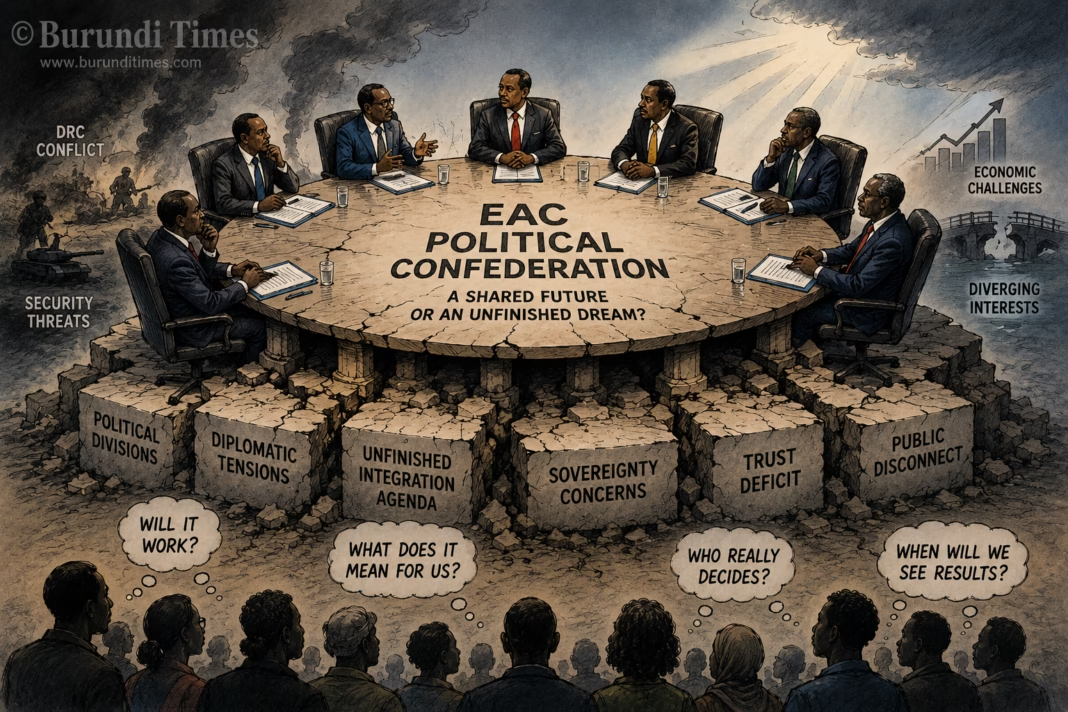

The East African Community’s renewed push to draft a constitution for a future Political Confederation is colliding with a geopolitical reality that may prove far more difficult to integrate than legal texts and institutional frameworks, a region increasingly defined by security crises, diplomatic tensions and diverging national interests.
The EAC Secretariat announced this week that consultations on the draft Constitution for the proposed Political Confederation will resume in Rwanda from June 15, bringing together government officials, lawmakers, civil society groups, academics and business leaders as part of a broader regional effort to shape the bloc’s future governance structure.
Yet the consultations come at a delicate moment for a bloc that has expanded rapidly while confronting some of the most complex political challenges in its history.
The Community now comprises eight member states, including the Democratic Republic of Congo and Somalia, both of which joined amid ongoing security challenges. The EAC’s own integration roadmap places Political Federation as the final stage of regional integration, following the Customs Union, Common Market and Monetary Union.
But critics and analysts argue that the bloc is attempting to deepen political integration at a time when member states remain divided on some of the region’s most pressing security and diplomatic questions.
The conflict in eastern DRC remains perhaps the clearest example. The crisis has repeatedly strained relations among regional governments, drawing in multiple diplomatic initiatives and exposing differing approaches to regional security. While EAC leaders continue to advocate closer political cooperation, the conflict has underscored the difficulty of forging common foreign and security policies among states with competing national interests.
“The challenge is not writing a constitution,” said one regional governance analyst based in Nairobi. “The challenge is whether member states are prepared to surrender even a small degree of political authority to regional institutions when they still disagree on fundamental security issues.”
The contradiction sits at the heart of the confederation project.
Under the proposed framework, the Political Confederation would strengthen cooperation in areas including political affairs, peace and security, foreign policy coordination and regional governance while serving as a transitional stage toward an eventual Political Federation.
Yet the EAC’s recent history suggests that regional consensus remains difficult even on less politically sensitive matters.
The bloc continues to grapple with delays in implementing key aspects of the East African Monetary Union, with officials acknowledging uneven progress toward macroeconomic convergence targets and institutional readiness. Analysts have pointed to fiscal disparities, public debt pressures and differing economic priorities among member states as obstacles to deeper integration.
Those challenges have raised broader questions about whether political integration can advance faster than economic integration.
The confederation model itself was adopted by EAC Heads of State in 2017 as a transitional arrangement intended to bridge the gap between existing integration structures and a future federation. A team of constitutional experts appointed in 2018 has since been leading consultations across partner states.
Supporters argue that deeper political coordination is necessary precisely because the region faces increasingly complex security, economic and geopolitical challenges.
The EAC has expanded significantly over the past decade, growing from six members to eight and extending its geographic reach from the Indian Ocean to the Atlantic-facing DRC. The enlarged bloc represents one of Africa’s most ambitious integration projects and one of its largest common markets.
But expansion has also introduced new complexities.
Somalia is still integrating into EAC institutions after becoming a full member in 2024, while South Sudan continues to face governance and security challenges. The admission of the DRC added immense economic potential but also brought one of Africa’s most volatile conflict environments into the regional fold.
As consultations begin in Rwanda, the question facing East African leaders may not be whether citizens support the idea of closer regional integration.
Rather, it is whether the region’s political realities are moving in the same direction as its constitutional ambitions.
For now, the EAC’s vision of a shared political future remains alive. Whether it can survive the pressures of an increasingly fragmented regional landscape may determine the future of East Africa’s most ambitious integration project.