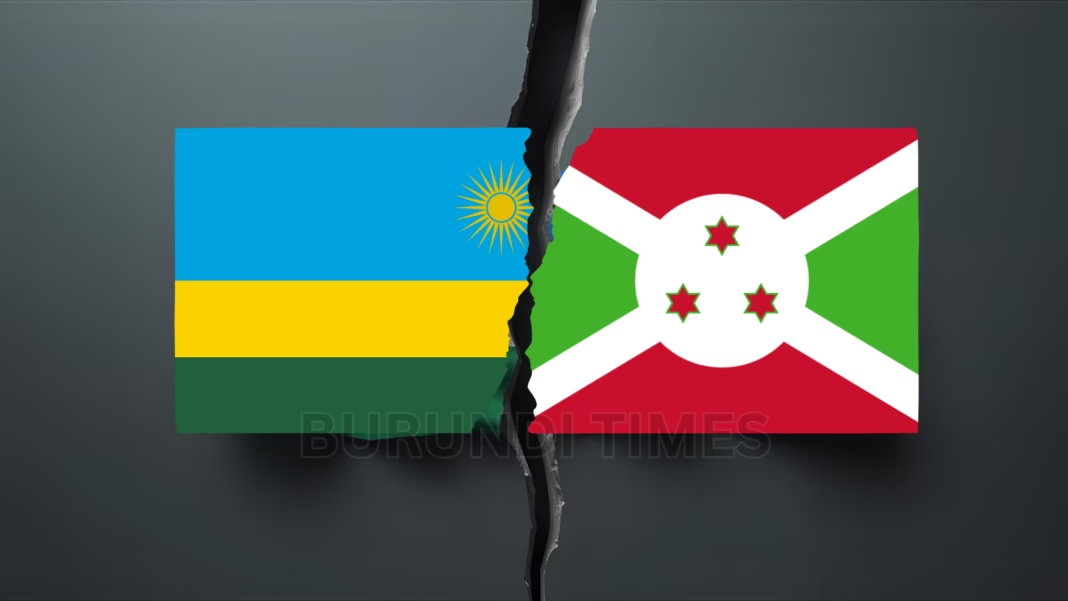

A diplomatic dispute between Burundi and Rwanda has taken a sharper turn following a public exchange that analysts say reveals deeper strategic tensions, with Rwanda’s top diplomat adopting an unusually combative and historically charged tone.
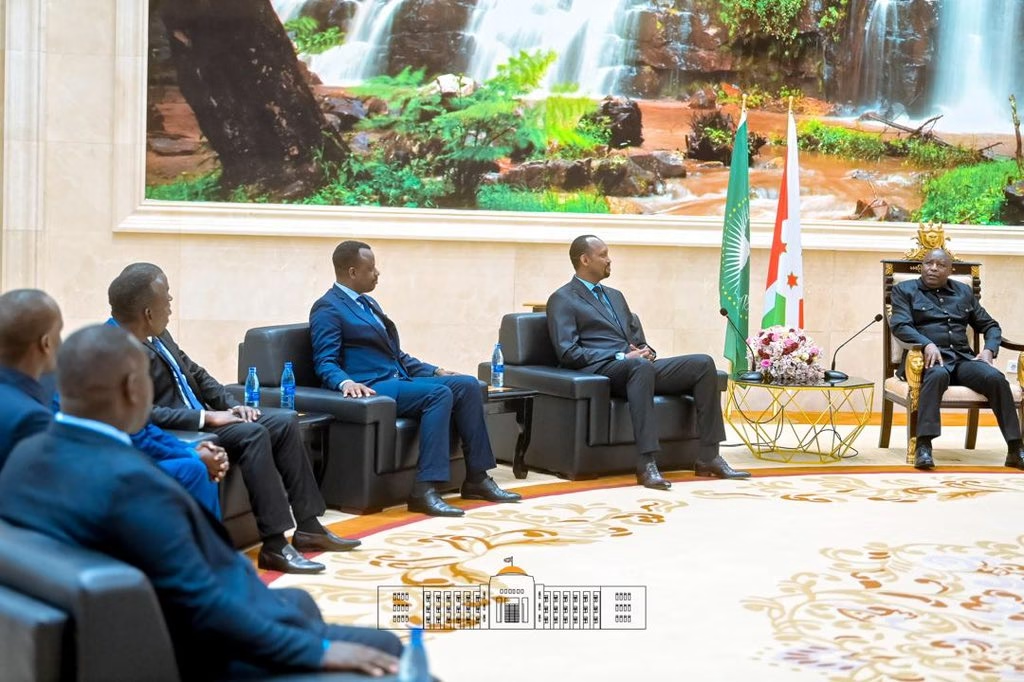
The clash was triggered by a post from the Presidency of Burundi announcing that President Évariste Ndayishimiye had received members of the Banyamulenge community in Bujumbura, a move framed by Burundian officials as an effort to engage a fragmented group with ties to the conflict in eastern Democratic Republic of Congo.
But Rwanda’s Foreign Minister, Olivier Nduhungirehe, responded with a lengthy and pointed critique that went beyond immediate policy concerns, invoking Rwanda’s own pre-genocide history and questioning both the legitimacy of the visitors and the intentions of the Burundian government.
“This kind of manœuvres of using people against their community is not new in our region,” Nduhungirehe wrote, referencing the rule of former President Juvénal Habyarimana and a period “when Tutsi were persecuted and killed in many parts of the country.”
Historical Framing Raises Questions
Analysts say the decision to draw a parallel with Rwanda’s early 1990s history a period culminating in the 1994 genocide is striking, and potentially inflammatory.
By invoking that era, Nduhungirehe appeared to elevate what might have been a routine diplomatic disagreement into a moral indictment. Such framing, observers note, risks conflating contemporary regional politics with one of the most traumatic chapters in modern African history.
“It’s not just criticism it’s narrative positioning,” said a regional political analyst in Kampala. “By referencing that period, Rwanda is implicitly assigning a very heavy historical meaning to Burundi’s actions.”
Nduhungirehe also dismissed the Banyamulenge delegation as “rogue individuals,” alleging they were unrepresentative of the broader community. However, he offered no public evidence to substantiate that claim, raising questions about how such determinations are made and by whom.
Competing Claims Over Representation
At the core of the dispute is a deeper disagreement over who speaks for the Banyamulenge a Tutsi-linked community whose identity and political alignment have long been contested.
Burundi’s approach, as reflected in Ndayishimiye’s meeting, appears to emphasize engagement across internal divisions. By contrast, Rwanda’s response suggests a narrower view of legitimate representation, one that critics say could reinforce fragmentation rather than resolve it.
Nduhungirehe’s post went further, suggesting the visiting group should travel to Minembwe to witness what he described as “daily airstrikes” and hardship affecting local populations. While concerns about violence in eastern Congo are widely documented, the minister’s remarks again blended humanitarian claims with political criticism, without providing verifiable sourcing within the post itself.
Burundi Pushes Back
Burundi’s Foreign Minister, Édouard Bizimana, rejected Rwanda’s framing and instead cast Burundi’s actions as inclusive.
“Who, between a President of Burundi who welcomes Banyamulenge of both sides of the aisle and a Rwanda government which considers one part of the community as rogue, is dividing [the] Banyamulenge community?” Bizimana wrote.
His response reframed the issue as one of openness versus exclusion, implicitly challenging Rwanda’s authority to define legitimacy within a community that extends beyond its borders.
Bizimana also dismissed Rwanda’s criticism as politically motivated, describing it as coming from “a minister under pressure of a cornered regime” a remark that underscores the depth of mistrust between the two governments.
Rwanda’s change in position
The exchange highlights how digital platforms are increasingly being used to wage diplomatic battles, often with fewer constraints than traditional channels.
However, analysts warn that such public confrontations can obscure as much as they reveal. While Rwanda’s intervention projects assertiveness, it also raises questions about consistency particularly given longstanding accusations, denied by Kigali, regarding its own involvement in eastern Congo.
The current spat is unfolding against a backdrop of evolving language from Kigali regarding armed groups in eastern Congo.
Rwanda has consistently denied supporting the M23 rebel movement. However, that position has come under renewed scrutiny following statements earlier this year by Rwandan officials.
In January 2026, Rwanda’s embassy in Washington acknowledged that Kigali engages in “security coordination” with the AFC/M23, describing it as a defensive response to what it called genocidal threats. The statement marked a notable shift from earlier blanket denials and aligned with longstanding findings by the United Nations that Rwanda has supported the group.
For critics including Burundi this evolution strengthens claims that Rwanda’s narrative has moved from outright denial to qualified justification.
By contrast, Burundi’s move to host the delegation though not without its own political calculations allows it to position itself as engaging directly with affected communities, rather than speaking about them from a distance.
Regional Stakes
The dispute unfolds against the backdrop of persistent instability in eastern Democratic Republic of Congo, where questions of identity, armed groups and external influence remain deeply intertwined.
Nduhungirehe’s latest comments on the Banyamulenge echo a broader pattern in Rwanda’s messaging: firm denials of backing armed groups paired with strong political alignment with their stated grievances.
In that context, the tone and content of Rwanda’s response may carry broader implications. By framing the issue in stark historical and moral terms while dismissing alternative voices within the Banyamulenge community, Kigali risks hardening divisions at a moment when regional cooperation is already fragile.
For now, the confrontation remains rhetorical. But as past crises in the Great Lakes region have shown, narratives especially those tied to identity and history can shape realities on the ground.
And in this case, the language chosen may prove as consequential as the policies behind it.