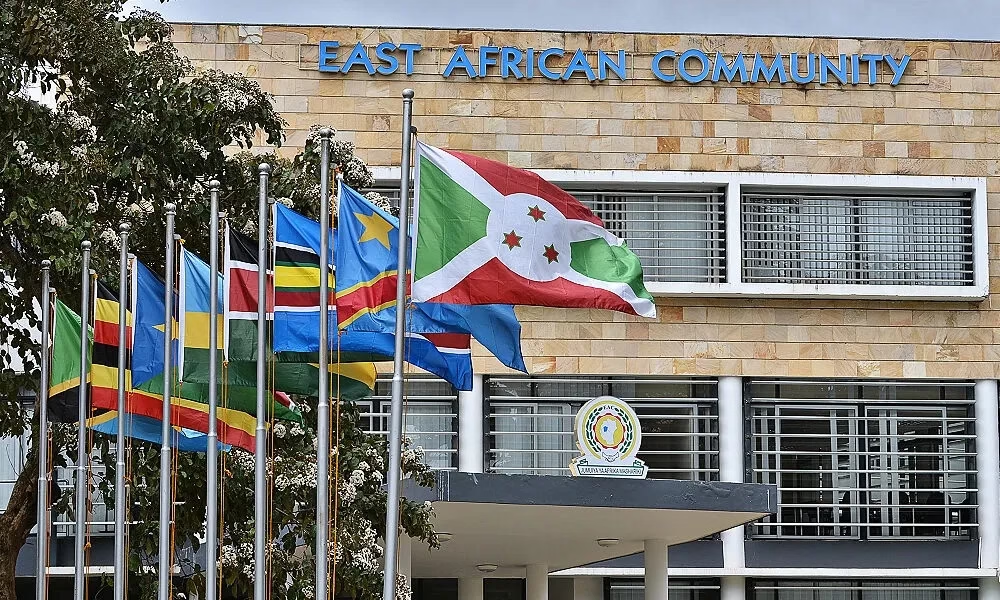

Three of the East African Community’s newest members owe nearly $60 million in outstanding contributions and arrears, highlighting the financial pressures facing the regional bloc as it seeks to reduce dependence on donors and implement a new financing model.
An internal EAC contribution status report reviewed by Burundi Times shows that as of May 18, 2026, the Democratic Republic of Congo (DRC), South Sudan and Somalia had not paid their assessed contributions for the 2025/26 financial year.
According to the report, DRC had outstanding obligations of $27.7 million, South Sudan $21.8 million, and Somalia $10.5 million. Together, the three countries account for approximately $60 million, or about three-quarters of the Community’s total outstanding obligations.
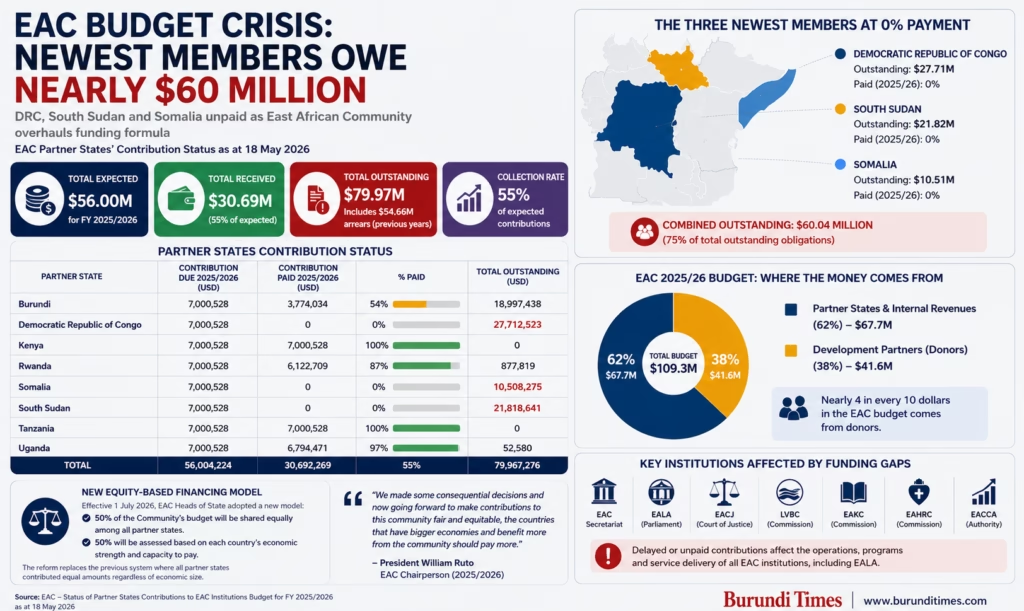
The report shows that partner states were expected to contribute $56 million to the EAC’s budget during the 2025/26 financial year. By May 18, however, only $30.69 million had been received, representing a collection rate of 55%.
Overall outstanding obligations stood at $79.97 million, while accumulated arrears from previous years totalled $54.66 million.
The figures underscore a growing challenge for the eight-member bloc, which has expanded rapidly in recent years with the admission of South Sudan in 2016, DRC in 2022 and Somalia in 2023.
While Kenya and Tanzania had paid 100% of their assessed contributions by mid-May, Uganda had paid 97%, Rwanda 87% and Burundi 54%. DRC, South Sudan and Somalia were recorded at 0% under the category “Contribution Paid 2025/2026.”
The contribution gap comes at a time when the EAC is increasingly reliant on external financing. The Community’s approved $109.3 million budget for the 2025/26 financial year projects that approximately 38% of funding will come from development partners, with the remainder expected from partner states and internally generated revenues.
The funding supports key regional institutions, including the EAC Secretariat, the East African Legislative Assembly (EALA), the East African Court of Justice (EACJ), the Lake Victoria Basin Commission and several specialized agencies responsible for implementing regional integration programs.
The latest contribution figures also provide context for a major financing reform approved by EAC Heads of State during their March summit in Arusha.
The reform replaces a system that largely required partner states to contribute equal amounts regardless of economic size. Under the new equity-based model, which takes effect on July 1, 2026, 50% of the Community’s budget will be shared equally among partner states, while the remaining 50% will be assessed according to each country’s economic strength and capacity to pay.
Announcing the decision, outgoing EAC Chairperson William Ruto said the objective was to make the system more sustainable and equitable.
“We made some consequential decisions and now going forward to make contributions to this community fair and equitable, the countries that have bigger economies and benefit more from the community should pay more,” Ruto said.
The summit also approved a one-time waiver of 50% of accumulated member-state arrears, a move widely viewed as an effort to reset the bloc’s finances after years of mounting unpaid contributions.
Supporters of the reforms argue that the new formula better reflects economic realities across the region. Critics, however, may question whether structural changes alone will address persistent compliance challenges among some member states.
For the EAC, the latest figures illustrate a broader dilemma facing regional integration efforts: balancing ambitious expansion and policy objectives with the financial commitments required to sustain the institutions that underpin them.