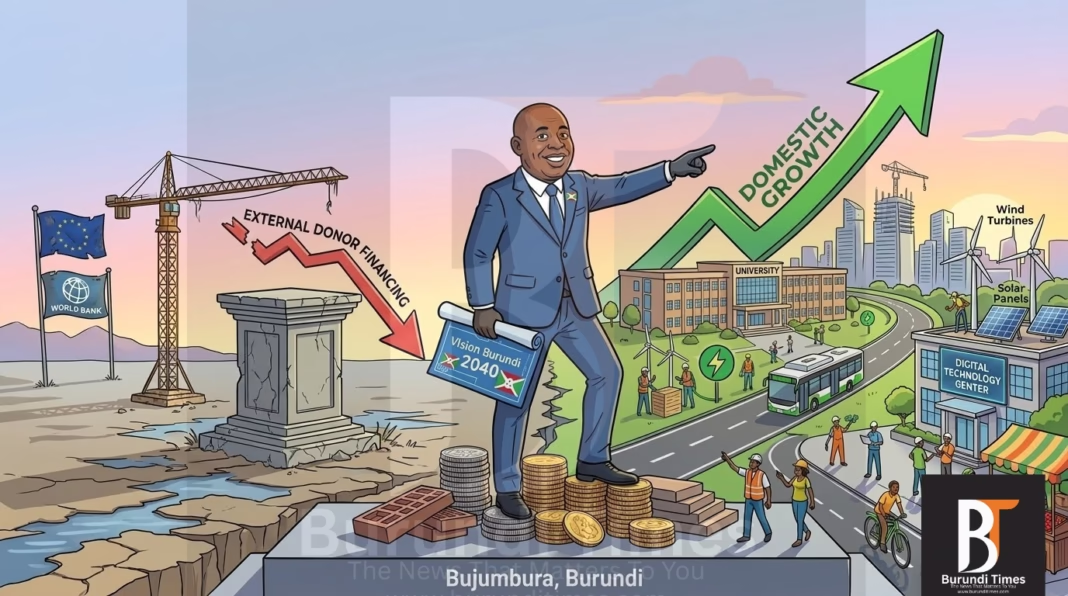

As foreign financing turns increasingly negative, Burundi is betting on a 75% increase in domestic revenue over two years to fund development, service debt and reduce dependence on external partners. The strategy is ambitious. The challenge is execution.
Burundi’s 2026/27 budget is more than a spending plan. It is a test of whether the country can finance a growing share of its development ambitions through domestic resources at a time when external financing remains constrained.
The figures approved by Parliament are striking. Domestic revenue is projected to reach 4.22 trillion Burundian francs (BIF), up from 2.41 trillion BIF in 2024/25. If achieved, that would represent a cumulative increase of roughly 75% in just two fiscal years.
At the same time, Burundi’s net external financing position is projected to deteriorate further, reaching negative 103.8 billion BIF in 2026/27, compared with negative 51.6 billion BIF a year earlier.
The shift reflects a broader fiscal strategy outlined in the budget tabled by Finance Minister Alain Ndikumana, which seeks to strengthen domestic resource mobilisation while financing priorities under the revised National Development Plan.
“The objective is to strengthen domestic resource mobilisation,” according to the 2026/27 budget document.
The numbers suggest Burundi is attempting one of its most ambitious fiscal transitions in recent years: replacing declining external financing with higher tax collection, expanded domestic borrowing and stronger revenue performance.
The Great Fiscal Shift
The headline figure in the budget is its size.
Total resources, including grants, are projected at 6.3 trillion BIF, while expenditure is expected to reach 6.74 trillion BIF.
Yet the more significant story lies in how the budget will be financed.
In 2024/25, domestic revenue covered roughly half of government expenditure. By 2026/27, the self-financing ratio is expected to exceed 62%.
That marks a substantial structural shift in Burundi’s public finances.
Rather than relying on expanding donor support, the government is increasingly turning toward domestic taxation and local financing sources to fund public spending.
The budget also projects domestic investment spending of 1.61 trillion BIF, a 35.7% increase from the previous fiscal year.
Government forecasts place economic growth at 5.5% in 2026/27.
The Revenue Mountain
The success of the strategy ultimately depends on one institution: the Office Burundais des Recettes (OBR).
The challenge facing the tax authority is significant.
Burundi is not merely targeting a 26% increase in revenue collection this year. It is attempting to increase domestic revenue by approximately 75% over two budget cycles.
Recent fiscal performance suggests the task will not be straightforward.
Budget reviews and parliamentary debates over recent years have highlighted concerns over uncollected taxes and revenue shortfalls. Findings by the Cour des Comptes also pointed to significant collection gaps between projected and realised revenues.
The issue is not whether revenue can grow.
The question is whether it can grow quickly enough to meet the assumptions underpinning the budget.
If collections fall short, additional borrowing may be required to fill financing gaps.
A New Wave of Taxes
To support revenue growth, the government has introduced a series of new tax and fee measures targeting sectors that have historically generated limited fiscal returns.
Among the measures are environmental levies, fishing royalties, customs-related charges and mechanisms designed to capture a greater share of proceeds from gold exports.
The budget also introduces a 2% regional integration levy on imports originating outside Africa, in line with East African Community commitments.
One of the most notable provisions appears in the explanation accompanying new cargo destination charges.
“Most applicants are Burundians disguised as Congolese,” the budget states, describing what authorities say is an abuse of cross-border customs arrangements.
Such explicit references to alleged fraud schemes are uncommon in budget legislation and underscore the government’s determination to tighten revenue collection.
Tax More, Exempt More
At the same time, the budget expands several tax incentives.
New exemptions cover electric vehicles, renewable energy equipment, telecommunications infrastructure and incentives linked to the development of Burundi’s stock market.
The rationale is to encourage investment in sectors viewed as critical for long-term economic transformation.
However, the policy also creates a fiscal balancing act.
Previous audits showed tax exemptions exceeding budgeted levels, raising concerns that revenue gains from new taxes could be partially offset if exemptions expand more rapidly than anticipated.
The Debt Question
Perhaps the most consequential figure in the budget is not a tax measure at all.
It is the projection that Burundi will once again be a net payer rather than a net recipient of external financing.
Net external financing is expected to fall to negative 103.8 billion BIF in 2026/27.
As external financing contracts, domestic borrowing continues to rise.
The budget projects net domestic borrowing of more than 545 billion BIF.
That trend has drawn attention from the Cour des Comptes.
“Excessive recourse to domestic financing risks compromising private sector efforts and the mobilisation of resources needed for development,” the institution warned in its assessment of previous budget execution.
The warning highlights a dilemma facing policymakers: financing development without constraining private-sector access to credit.
Where the Money Goes
The expenditure breakdown reveals both priorities and constraints.
The Ministry of Finance, Budget and Digital Economy accounts for 41.6% of total budget allocations, by far the largest share.
Much of that allocation reflects debt servicing and fiscal management obligations rather than direct programme spending.
Education receives 10.9% of expenditure, followed by defence at 9.6%, agriculture at 8.9%, infrastructure at 5.6% and health at 4.5%.
The figures illustrate the competing pressures facing government finances: investing in growth while managing rising financing obligations.
A Budget Built on Execution
Burundi’s 2026/27 budget sets out a clear strategic direction.
The government aims to reduce dependence on external financing, mobilise more domestic revenue and expand investment spending.
The arithmetic is ambitious.
The outcome will depend less on the targets themselves than on the state’s ability to deliver them.
Over the next twelve months, three indicators will offer the clearest measure of success:
- OBR revenue performance.
- Growth in domestic borrowing.
- The cost of tax exemptions.
Together, those figures will reveal whether Burundi is moving toward greater fiscal self-reliance—or whether the country’s largest budget becomes another example of fiscal ambitions outpacing implementation.