
Burundi may struggle to reach its goal of becoming an emerging economy by 2040. It might fail if it does not lower the cost and uncertainty of doing business.
The East African Business Council (EABC)’s executive director said Friday that Burundi’s competitiveness hinges on electricity reliability. It also depends on border clearance times and access to foreign exchange and credit.
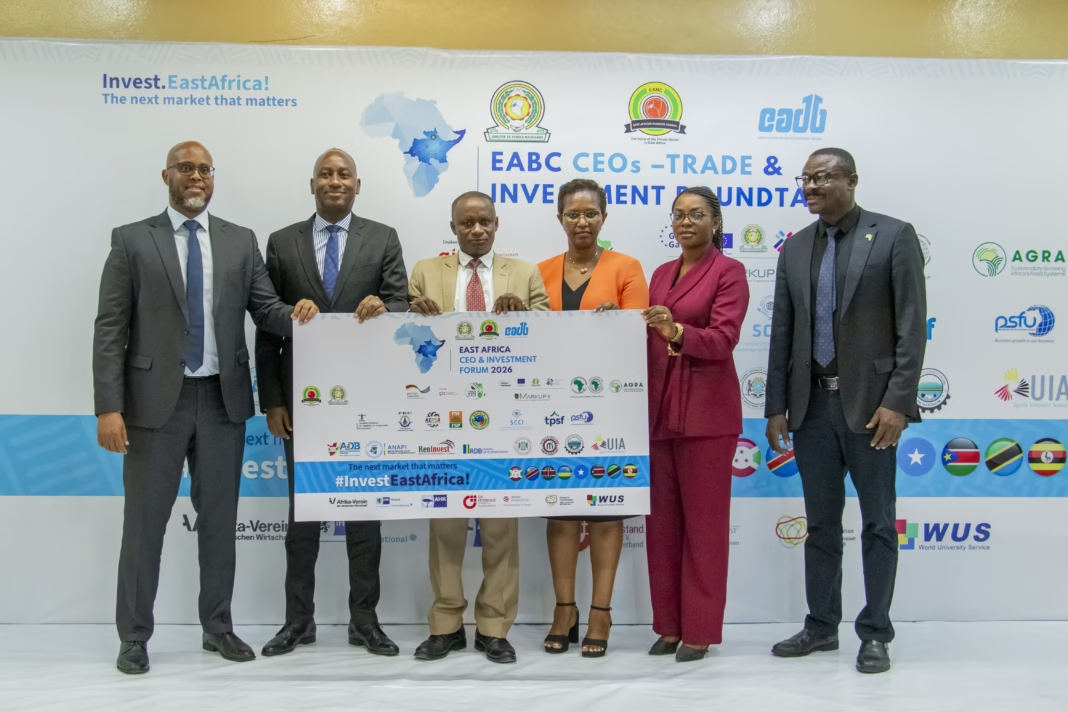
Ahmed Farah made the comments in his opening address at the EABC CEOs–Trade and Investment Roundtable in Bujumbura, where business leaders and government officials discussed how to improve Burundi’s trade and investment climate within the East African Community.
“Competitiveness is embedded in our experiences on reliable electricity, on the time it takes for our goods to move across borders,” Farah said. “It’s manifested in our ability to access foreign exchange and credit.” Competitiveness, he said, is not an abstract economic concept but something businesses feel directly through the cost of producing, financing and moving goods.
EAC: barrier removal remains a priority
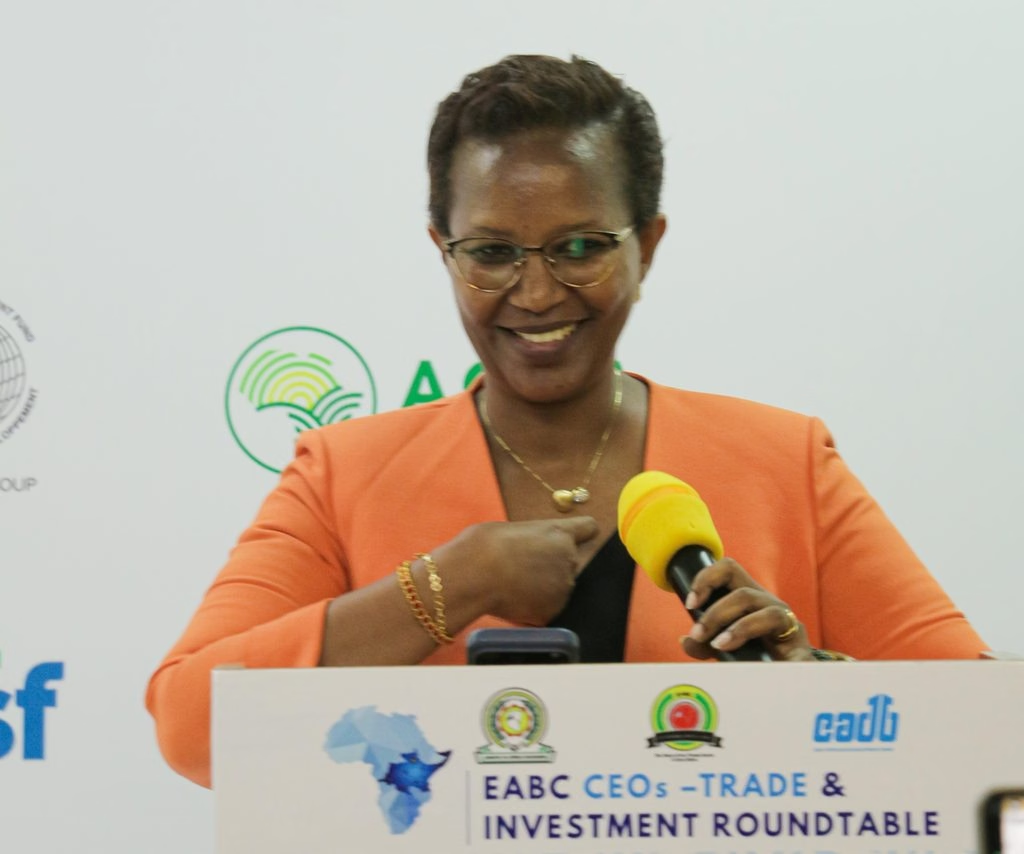
Flavia Busingye, the EAC’s director of customs and trade, said competitiveness requires tackling a wide set of constraints beyond non-tariff barriers alone: high transport and logistics costs, inefficient border procedures, inadequate infrastructure, duplicated standards, limited trade finance, costly cross-border payments, fragmented digital systems and unpredictable regulations.
“These challenges affect all businesses, but especially MSMEs, women and youth entrepreneurs, who have less capacity to absorb delays and additional costs,” Busingye said.
She said eliminating non-tariff barriers remains an EAC priority, backed by stronger reporting, monitoring and escalation mechanisms, and that partner states must also prevent resolved barriers from resurfacing and align national laws with regional commitments. The private sector, she said, has an important role in reporting barriers promptly so authorities can act before problems become systemic.
Busingye pointed to EAC investments in One Stop Border Posts, coordinated border management, the Single Customs Territory and electronic cargo tracking, but cautioned that infrastructure alone isn’t enough: “Agencies must cooperate, systems must be interoperable, procedures simplified and decisions implemented consistently.”
For Burundi, she said, efficient transport corridors, border posts and market access matter a great deal, and improved connectivity would strengthen both Burundi’s economy and the EAC’s overall resilience. She also called for deeper regional value addition and industrialization, saying the Common External Tariff should support regional value chains while keeping access to essential inputs predictable naming agro-processing, manufacturing, pharmaceuticals, textiles, leather, horticulture and minerals as strategic sectors.
Businesses press EAC on trade barriers
Olivier Suguru, chairperson of the Federal Chamber of Commerce and Industry of Burundi (CFCIB), said the roundtable gave the private sector an important platform to identify barriers preventing Burundian businesses from fully benefiting from regional opportunities, and thanked EAC leadership for its engagement.
He pointed to the EAC’s 25th Ordinary Summit in Arusha on March 7, 2026, where heads of state directed partner states to resolve all outstanding non-tariff barriers by June 30, a deadline he called “significant and welcome,” since many of the barriers in question have persisted for years, raising costs and undermining intra-EAC trade. But with that deadline now passed, Suguru said, some of the same barriers are already reemerging, “a matter of concern for the private sector,” and he urged the EAC Secretariat and partner states to strengthen monitoring and accountability so regional commitments translate into real improvements for business.
Narrow export base a risk
Farah said Burundi’s economy grew about 4.2% last year, helped by coffee and gold exports, while inflation fell sharply from its previous peak encouraging, he said, but built on a narrow commodity base exposed to global prices Burundi doesn’t control. “The prices of gold and coffee are largely in the hands of others,” he said, calling for a wider export base and more value captured at home through processing. “We need more products, we need more value addition.”
He said the road to 2040 is a productivity agenda: more value from every hectare of farmland, every unit of electricity, every transport route and every franc of credit. With agriculture accounting for roughly 85% of employment, that means higher yields, higher-value crops, better irrigation and storage, and fewer post-harvest losses. “Growth must come from higher yields, higher-value crops, fewer post-harvest losses, and more processing value,” he said.
On electricity, Farah pointed to the Jiji Mulembwe project and Burundi’s share of the Rusumo Falls hydropower scheme, together adding more than 76 megawatts of capacity good progress, he said, but only meaningful once businesses can rely on it. “The next test is where businesses experience it reliable factories, cold rooms, irrigation pumps,” he said. “That’s when power becomes development: when it runs a machine and lowers production costs.”
Lake Tanganyika as untapped trade asset
Farah said Burundi should make fuller commercial use of its position on Lake Tanganyika. “Lake Tanganyika is not simply a scenario it is commercial infrastructure,” he said, adding that reliable lake transport, efficient ports, border systems, warehousing and connected roads could position Bujumbura as a logistics hub for the EAC and the wider Great Lakes region. “A day saved in transit is working capital returned to business,” he said.
Finance and predictability
Farah called for wider access to productive finance for small and medium-sized enterprises, equipment financing, leasing, supplier and warehousing finance, export credit, guarantees and SME-tailored insurance. “Trade finance keeps commerce moving, but productive finance changes an economy,” he said.
He also pressed government to cut the “cost of uncertainty” facing businesses: stable rules, transparent access to foreign exchange, reliable fuel and power, consistent customs decisions and predictable approval timelines. “A business should not have to start the same conversation at every public office,” he said.
Government backs regional integration
Séverin Mbarubukeye, permanent secretary for East African Community affairs at Burundi’s Ministry of Foreign Affairs, said the country is at a pivotal stage in its economic transformation and is rolling out both macroeconomic and microeconomic reforms. “Burundi recognizes that regional integration is the most practical path toward prosperity,” he said.
Farah urged participants to move past speeches and agree a practical action plan setting out barriers, responsible institutions and timelines. He said input from the roundtable would feed into the inaugural East Africa Trade and Investment Climate Report, due to launch Sept. 17 at the East Africa CEO and Investment Forum.
Burundi, he said, does not need to be a large economy to compete regionally it needs to be a reliable one. “By 2040, let us see Burundian brands on regional shelves,” Farah said.