
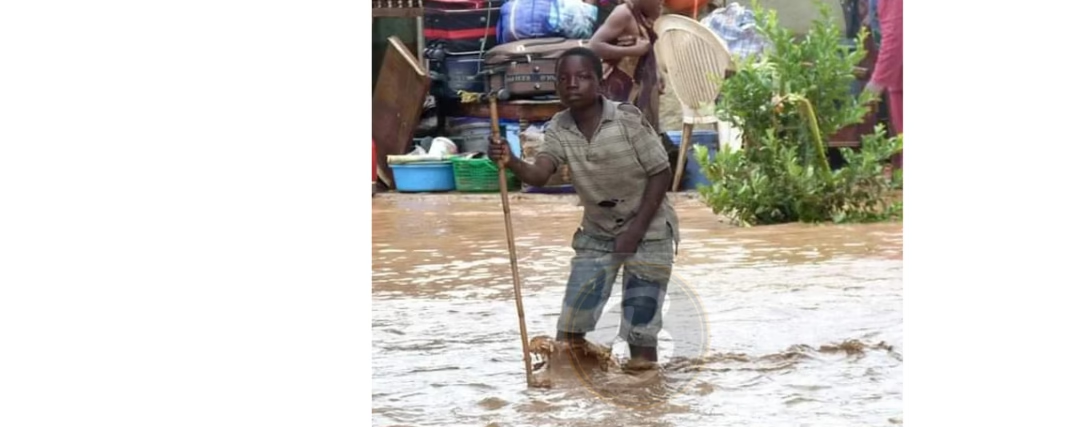

Burundi is heading into another rainy season with the same vulnerabilities that produced one of its worst disasters in recent memory. The question now is whether anything has actually changed.
Two places illustrate the stakes: Gatumba, where the Rusizi River and Lake Tanganyika have repeatedly swamped homes and farmland, and the Bujumbura–Rumonge road corridor, where heavy rain regularly triggers landslides and cuts off transport.
Neither risk is new. What has changed is the scale of proof required that the government has learned from the last crisis.
The 2023–24 disaster, in numbers
Between September 2023 and May 2024, more than 298,000 people in Burundi were affected by torrential rains, floods, landslides and the overflow of Lake Tanganyika, according to a UNHCR situation report. Homes, schools, health facilities, roads, crops, water networks and electrical installations were all damaged or destroyed.
By June 2024, the International Rescue Committee reported that the lake had climbed to 777.04 metres just 36 centimetres short of the record set in 1964, citing figures from Burundi’s head of Civil Protection.
Those numbers set the baseline against which this year’s preparedness should be judged.
Gatumba: unfinished business
Gatumba, on the Imbo Plain near the border with the Democratic Republic of Congo, is the clearest test case. The International Organization for Migration has documented how persistent rain, flooding, landslides and strong winds have repeatedly pushed the lake to dangerous levels there.
What’s less clear is whether the response has actually reduced the danger or just bought time. A January 2025 report by D+C found that flood-protection works in the area had been suspended by the Ministry of Interior the previous September, with roughly two kilometres completed.
Nearly two years on, that leaves open questions the government has yet to answer publicly whether the project resumed, and how much is finished. And whether the original design even sufficient for current flood risk.
These aren’t procedural details. Preparedness isn’t measured by how quickly aid arrives after homes flood, it’s measured by the drainage, evacuation routes and early-warning systems in place before the water rises.
Two hazards, not one
Lake-level rise and landslide risk are often discussed together, but they aren’t the same problem. Rising water inundates low-lying settlements, farmland, roads and other infrastructure along the shore in Gatumba, the interaction between the lake, the Rusizi River and flat terrain makes drainage especially difficult.
On the road to Rumonge, the danger comes from saturated soil and increased runoff destabilizing slopes, which can block transport and cut off access to hospitals and markets.
The distinction matters for accountability. A rising lake doesn’t explain every landslide on the RN3. That means the burden is on the government to show that road rehabilitation projects, including work documented by the African Development Bank and supervision activity reported by Burundi’s roads agency in 2026 — actually build in drainage, erosion control and slope stabilization, rather than simply repaving after damage occurs.
What the forecast does and doesn’t tell us
The World Meteorological Organization has warned of a warmer, wetter-than-usual October–December period across the Greater Horn of Africa as El Niño strengthens. That’s a regional signal, not a local prediction — it doesn’t mean Gatumba or the RN3 will necessarily flood or slide this year.
What it does mean is that the burden shifts to Burundi’s own meteorological and civil protection authorities to translate that regional outlook into local risk assessments and action. Are vulnerable communities getting timely alerts? Are evacuation routes and shelters ready? Are emergency supplies pre-positioned? Have local authorities been told to prepare for possible displacement? Are road crews equipped to clear slides quickly?
The accountability gap
Disaster-risk-reduction programs exist but what hasn’t been established is whether they’ve actually reduced Burundi’s exposure to the next disaster and that requires evidence, not assurances.
For Gatumba, it means an honest accounting of the flood-protection works: what’s built, what’s stalled, and whether the design matches the risk. For the Bujumbura–Rumonge corridor, it means scrutinizing the engineering behind rehabilitation projects, not just their existence. Nationally, it means transparency on the disaster-preparedness budget, Civil Protection’s capacity, and contingency plans for mass displacement.
Residents also deserve clarity on who’s responsible for what, which agency monitors lake levels, who issues warnings, who orders evacuations, who maintains the roads that keep communities connected during a crisis.
The test ahead
Burundi cannot control El Niño, and it cannot eliminate every hazard tied to Lake Tanganyika or its steep terrain. What it can control is how much those hazards cost in lives and livelihoods through land-use enforcement, drainage, infrastructure maintenance, early warning and evacuation planning.
The 2023–24 floods are the baseline. Hundreds of thousands of people were affected, and many communities still haven’t fully recovered. Another disaster on that scale would fall on people who are still rebuilding from the last one.
For residents of Gatumba and those who rely on the Bujumbura–Rumonge road, the question isn’t abstract: if the rains come hard again this year, will the response look any different than it did last time?
That answer won’t be found in government assurances. It will be found in finished projects, functioning warning systems, accessible evacuation plans and infrastructure built to withstand hazards Burundi already knows are coming.