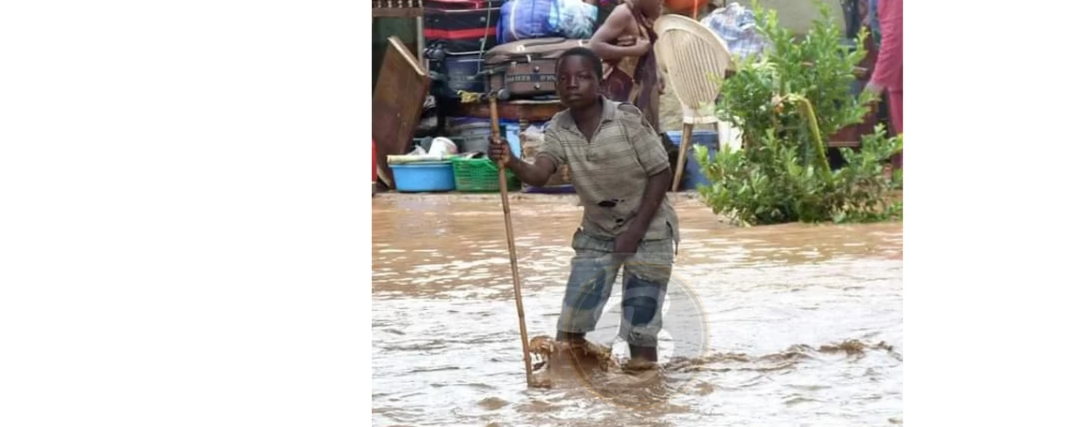


A new flood-protection dike has been built along the Rusizi River in Gatumba, the Burundian town hit hardest by repeated flooding from Lake Tanganyika, as the country heads into a rainy season forecasters say will be wetter than normal.
The roughly 2.5-kilometre dike was constructed by Caritas Burundi with funding from Catholic Relief Services (CRS), at a cost of about 100 million Burundian francs, and was completed this month. The Diocesan Organization for the Development of Bujumbura (ODDBU) carried out the construction, which includes a roughly 100-metre buffer zone between the river and the dike intended to prevent hippopotamuses from damaging the structure. Local residents and administrators will be responsible for maintaining the dike going forward, including a planned tree-planting effort to reinforce it.
An earlier community-led attempt to protect Gatumba using sandbags, backed in part by contributions from the Burundian diaspora, had stalled for lack of resources before Caritas and CRS took on the project.
The project follows years of flooding in Gatumba, on the Imbo Plain near the border with the Democratic Republic of Congo, where Lake Tanganyika and the Rusizi River have repeatedly inundated homes and farmland since 2016. Between September 2023 and September 2024, more than 298,000 people across Burundi were affected by rains, floods, landslides and the overflow of Lake Tanganyika, according to the U.N. refugee agency, UNHCR. Roughly 96,000 to 100,000 people were displaced during that period, according to the International Federation of Red Cross and Red Crescent Societies and Al Jazeera; no official government figure has been released. In April 2024, Lake Tanganyika rose to 777.04 metres, 36 centimetres below the record set in 1964, according to the International Rescue Committee, citing Burundi’s head of Civil Protection.
An earlier flood-protection effort in Gatumba was suspended by the Ministry of Interior in September 2024 after roughly two kilometres were completed, according to a January 2025 report by the German development-policy magazine D+C. It is unclear whether that project and the newly completed Caritas-led dike are the same undertaking under different management or two separate efforts.
Not all similar projects in the Bujumbura area have moved forward. A related effort to dredge the Kinyankonge canal in Buterere, another flood-prone area of the capital, remains suspended, with roughly 900 metres of a planned 1.3-kilometre canal-clearing project completed before work was halted due to informal construction along the canal that needs to be cleared first. That project has an estimated cost of 80 million Burundian francs.
Separately, the World Bank’s $113 million Urban Resilience Emergency Project for Bujumbura, financed through a $60 million grant from the International Development Association and $53 million from the Bank’s Crisis Response Window, became effective in September 2024 and was formally launched in November of that year. The project funds flood-risk infrastructure, early-warning systems and climate-resilient urban planning for the capital, but the World Bank’s most recent implementation status report does not detail how much of the funded work has been completed.
The developments come as forecasters warn of an elevated flood risk this rainy season. The World Meteorological Organization and Kenya-based IGAD Climate Prediction and Applications Centre have forecast wetter-than-normal conditions across the Greater Horn of Africa, including Burundi, between October and December 2026, as a strong El Niño strengthens.
Scientists have also documented a longer-term rise in the lake. Researchers from the International Atomic Energy Agency, working with Burundian scientists on an isotope-hydrology study published in May 2026, said Lake Tanganyika’s water levels have risen by more than a metre over the past five years, submerging lakeside housing, closing beaches and damaging roads and hotels along its shores.
Questions remain about the scale of the response relative to the risk. A national platform for disaster-risk reduction has previously said that a two-kilometre dike is insufficient to protect a vulnerable shoreline stretching roughly 12 kilometres in the Gatumba area, and that the government’s own budget for a earlier, publicly funded dike proposal was around $350,000. It was not immediately clear how the new Caritas-led dike’s length compares to the full extent of exposed shoreline, or whether additional sections are planned.