
Gold-bearing soil from a mining site controlled by the M23 armed group in eastern Congo was shipped by boat across a lake to a collection point in Rwanda, according to an Amnesty International investigation released Monday.
The report details what Amnesty says is a cross-border mineral pipeline linking M23-controlled mines in South Kivu province to Rwanda. It also accuses the group of committing widespread abuses against miners, including killings, torture and forced labor.
Amnesty said researchers interviewed 26 people, including miners, mining experts, mine shaft owners and relatives of victims, and reviewed photographs and video evidence. The investigation centered on a coltan mine near Rubaya in North Kivu province and the Lomera gold mine in South Kivu.
At Lomera, Amnesty said, gold-bearing soil known locally as “robotas” was loaded onto boats at the mine’s port and ferried across the lake to a sand collection site in Kamembe, a town in Rwanda’s Western Province.
One Congolese miner told Amnesty he watched at night as M23 fighters gathered mineralized soil from several mine shafts and moved it toward the lake.
“When they arrived, they put it in small boats and sent it to Rwanda,” he said.
Another miner described a routine flow of boats and traders from Rwanda.
“We saw (boats being loaded). Loaded with robotas (sacks of soil containing gold). They did this very early in the morning. Each morning, they came with traders from Rwanda. And the same boats came at night,” he said.
Amnesty’s Evidence Lab also reviewed material related to the movement of gold from Lomera to Rwanda, the organization said.
Killings and forced labor documented
Amnesty said the alleged trafficking occurred alongside widespread abuses against miners in territory controlled by M23, which the group described as Rwanda-backed. Researchers documented allegations of summary killings, torture, arbitrary detention, forced labor, forced recruitment and pillage.
Amnesty said 18 artisanal miners were killed at the Rubaya and Lomera sites, according to witnesses and relatives interviewed by researchers. Ten were beaten to death, two were shot, and six who had been abducted were later found dead, the group said.
Amnesty said the scale of the alleged trade goes beyond smuggling and that M23’s seizure and sale of gold and coltan could amount to the war crime of pillage.
Agnès Callamard, Amnesty International’s secretary general, said the findings raise questions about responsibility beyond M23 itself.
“This investigation should serve as a wake-up call to Rwanda that Rwandans may bear international criminal responsibility for facilitating the trafficking of pillaged minerals to Rwanda,” Callamard said.
She said Rwanda could also bear state responsibility for abuses at the mining sites if Rwandans working there were acting under the direction or control of the Rwandan government.
A route documented before
The findings build on earlier United Nations reporting on mineral trafficking from M23-held territory. A 2025 report by the U.N. Group of Experts on Congo said the AFC/M23 alliance controlled mineral transport routes from Rubaya to Rwanda and held a monopoly over coltan exports along that route. The U.N. experts also said minerals from Rubaya were being mixed with Rwandan production.
Amnesty’s report focuses on two mining sites and adds new witness testimony specifically about the movement of gold from Lomera.
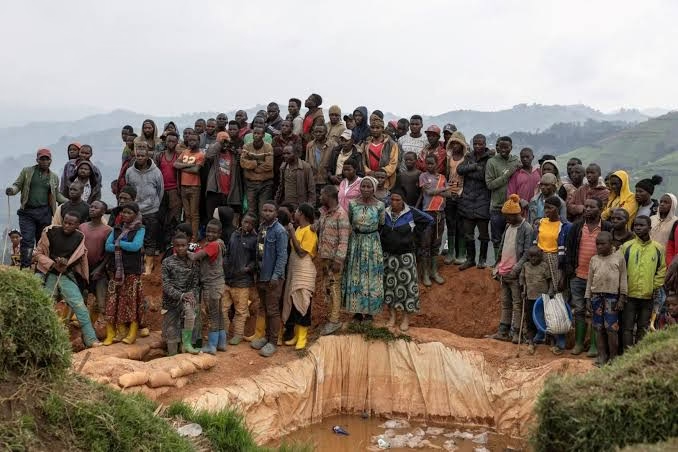
The group said M23 controls dozens of artisanal mines across North and South Kivu provinces, where tens of thousands of people depend on mining for their livelihoods. Access to the mines is tightly restricted, Amnesty said, and neither site it investigated has independent international oversight.
At Rubaya, miners told Amnesty that some Rwandans worked as civilian miners or mine shaft managers, while others took part in combat alongside M23 fighters when needed. Some security guards who identified themselves as Rwandan, or who spoke Kinyarwanda, worked alongside M23 and were involved in beating and mistreating miners, according to the report.
Neither M23 nor Rwandan government officials responded to requests for comment from Amnesty, the organization said.
Supply chain concerns extend beyond the region
Amnesty said the allegations carry implications beyond the Great Lakes region because gold and coltan from the area move through international supply chains and end up in consumer electronics.
The organization called on companies buying minerals from Rwanda, or from processors and refineries supplied by Rwanda, to recognize the risk that those minerals originated in conflict-affected parts of eastern Congo.
“The brutality of the crimes detailed in this report should be a warning for all corporations buying minerals from Rwanda,” Callamard said. “These minerals are likely to be trafficked into Rwanda from eastern DRC, where miners are the victims of horrific abuses at the hands of Rwanda-backed M23.”
Amnesty urged governments and companies to halt purchases of coltan and gold from Rwanda, including through third-country processors and refineries, until Rwanda provides evidence it has stopped receiving minerals trafficked from Congo. It also called on the United States and European Union member states to avoid entering mining agreements involving Rubaya or other M23-controlled mines unless independent human rights observers are granted full access.
The report leaves open a question for regulators and buyers: how minerals entering Rwanda’s supply chain can be reliably distinguished from gold and coltan mined in M23-controlled areas of eastern Congo.
For Amnesty, the group said, the issue no longer stops at the battlefield — it runs through the mineral trade to companies and consumers far from the Great Lakes region.