
Belgium and Rwanda have restored diplomatic relations after an 18-month rupture over the conflict in eastern Democratic Republic of Congo, reopening their embassies while acknowledging that major disagreements over the regional crisis remain unresolved.
Belgian Foreign Minister Maxime Prévot and Rwandan Foreign Minister Olivier Nduhungirehe announced the decision Tuesday on the sidelines of the United Nations General Assembly in New York. The two countries said relations were formally restored on Sept. 22, following months of meetings and informal contacts between the ministers.
Both embassies will initially reopen under a chargé d’affaires rather than an ambassador, with ambassadorial appointments to follow later.
The restoration marks a sharp reversal from March 2025, when Rwanda broke relations with Belgium and the two countries expelled each other’s diplomats amid escalating tensions over Belgium’s stance on the war in eastern Congo. Belgium’s Foreign Ministry said in June that Rwanda had severed ties with immediate effect on March 17, 2025, forcing the closure of Belgium’s embassy in Kigali and shifting some consular services to Nairobi.
Dispute over eastern Congo remains
The diplomatic thaw does not resolve the two countries’ underlying differences over eastern Congo. Belgium continues to support the DRC’s territorial integrity and sovereignty, while Rwanda rejects accusations that it is fueling the M23 rebellion’s military advances in the region.
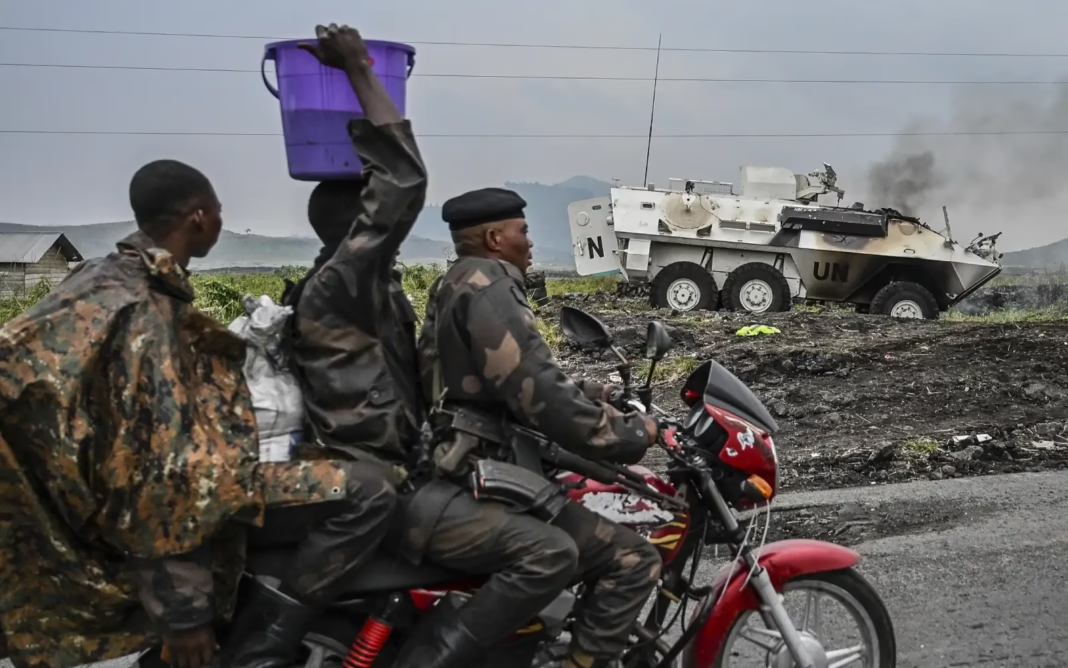
M23 and its political-military alliance have controlled large areas of North and South Kivu since a major offensive in early 2025 that captured Goma and Bukavu, two of the region’s largest cities. The United Nations and several Western governments have accused Rwanda of backing M23 — an allegation Kigali consistently denies, saying its security concerns stem from armed groups operating in Congolese territory, including the Democratic Forces for the Liberation of Rwanda (FDLR).
The conflict remains one of the central diplomatic flashpoints in the Great Lakes region, drawing in the DRC, Rwanda and a broader network of regional and international mediation efforts.
Prévot said restoring relations did not require Belgium to abandon its position on Congo. “Restoring diplomatic relations between states does not mean abandoning our position, but having structured channels for dialogue,” he said, according to Reuters, adding that Belgium would continue defending the DRC’s territorial integrity and sovereignty. Belgium has said it wants to draw on its regional expertise to support mediation efforts, and has urged all parties to honor their commitments under the Doha and Washington peace processes.
The joint statement credited Qatar with helping restart direct communication between Kigali and Brussels, noting that Doha facilitated the first meeting between Prévot and Nduhungirehe in June 2025 — just months after ties were severed. The ministers held further meetings and informal contacts afterward, discussing what the statement called differences and misunderstandings.
Both governments agreed that future relations would be guided by noninterference, mutual respect and constructive engagement, and committed to maintaining open, candid and transparent dialogue — including on international issues where their positions still diverge. The reopening thus comes without a settlement of the underlying Congo dispute.
Embassies to reopen
Each embassy will initially be headed by a chargé d’affaires ad interim, supported by a diplomat or consular official and a small technical team; requests for ambassadorial accreditation will follow later. Rwanda’s ambassador to Belgium is also expected to be accredited to the European Union, according to the joint statement.
For Belgium, the change ends more than a year in which its Kigali embassy stayed closed and visa applicants were redirected to alternative consular arrangements, including in Nairobi.
The timing carries weight for the wider Great Lakes region, where diplomatic efforts continue on the eastern Congo conflict. Belgium, a member of the International Contact Group for the Great Lakes, has called for renewed commitment to ceasefires and negotiations amid continued violations in the east.
The restored Belgium-Rwanda relationship thus reopens a channel between two governments still divided over the Congo conflict while adding another diplomatic avenue as regional peace efforts continue.