
The East African Community is seeking about $45 million to strengthen the region’s ability to detect and respond to Ebola and other high-consequence infectious diseases, as the bloc expands its network of mobile laboratories and trains health workers across its eight member states.
The funding request reflects a broader push to build a regional surveillance and response system capable of detecting outbreaks quickly and managing them across national borders, a persistent challenge in a region where diseases can spread faster than national health systems can coordinate.
The EAC currently operates 10 mobile laboratories across seven Partner States, including sites at Beni, Busia, Nimule-Elegu, Kobero and Bwera. These labs have supported outbreak responses for Ebola, Marburg virus disease, COVID-19 and Mpox, according to the EAC. The bloc plans to expand the network to 34 mobile laboratories by the end of 2027, though it has not released a deployment timetable for the additional 24 units.
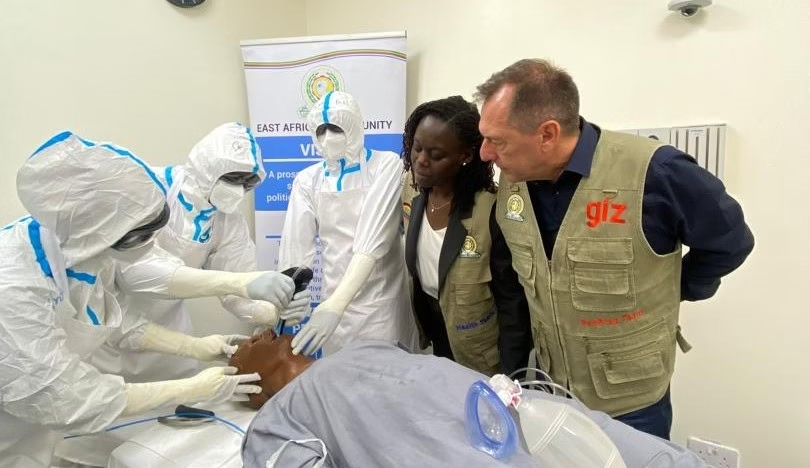
In parallel, 120 doctors, nurses and other frontline health workers from all eight Partner States are undergoing specialized training in Nairobi through the Training in the East African Community for High-Consequence Infectious Diseases (tEACh) programme, implemented by the EAC with support from Germany’s development agency, GIZ.
The curriculum covers core outbreak-response competencies: identifying and isolating suspected cases, infection prevention and control, correct use of personal protective equipment (PPE), safe sample collection, patient management and emergency response. The programme also aims to build a pool of trained specialists who can cascade this training to health workers in their home countries.
“Through this regional training, the EAC is building a common pool of health professionals with the practical skills to detect, manage and contain outbreaks while strengthening the ability of Partner States to respond together when a public health emergency occurs,” said Dr. Dorcas Omukhulu, EAC acting director of social sectors.
Regional response, regional infrastructure
Cross-border movement of people and goods through East Africa’s major transport corridors and border crossings makes coordinated, regional surveillance essential rather than optional. The EAC’s mobile laboratories are designed to place diagnostic capacity closer to at-risk communities and strategic points of entry, enabling faster confirmation of suspected cases and reducing the delay between symptom onset and containment measures.
The bloc estimates $45 million is needed to mount an effective response to Ebola and other viral hemorrhagic fever outbreaks in the region and is appealing to development partners for additional support.
Germany commits €4.8 million
Germany has separately pledged €4.8 million to bolster the EAC’s Ebola preparedness and response capacity. The funding is earmarked for training 500 frontline health workers, community sensitization reaching 15,000 people in eastern Democratic Republic of Congo, procurement of 20,000 sets of PPE, and support for registering new Bundibugyo ebolavirus vaccines in EAC Partner States pending World Health Organization approval.
The package extends the response beyond clinical and laboratory capacity to include community engagement, protective equipment supply chains and vaccine access — three areas frequently identified as weak points in past Ebola responses.
GIZ Programme Manager for Support to Pandemic Preparedness in the EAC Region Burkard Kömm said trained personnel alone are not sufficient. “Effective response to a high-consequence infectious disease depends on trained people, the right equipment and systems that work across borders,” he said, adding that the programme is designed to build capacities that remain within the region long-term.
The Nairobi training is hosted at the Aga Khan University Centre for Innovative Medical Education and delivered by clinical experts from Charité – Universitätsmedizin Berlin, East African clinicians trained through the programme’s Training-of-Trainers track, representatives of national Emergency Operations Centres, and the WHO.
Building capacity before the next outbreak
For participants, the emphasis is on hands-on readiness rather than classroom instruction. “This training strengthens the practical skills and confidence we need to respond safely and effectively during an outbreak,” said Dr. Pius Mutuku, a medical epidemiologist at the Kenya National Public Health Institute and a participant in the programme.
The training runs through November 2026, as the EAC works toward a self-sustaining pool of clinical experts and trainers across all eight Partner States.
The initiative underscores a structural reality for the region: infectious diseases that cross borders require response systems that do the same. The EAC’s preparedness strategy rests on three interconnected pillars, trained frontline personnel, diagnostic capacity and cross-border coordination systems, and its funding appeal signals that scaling these systems further will depend on sustained support from international partners.