
President Donald Trump has proposed replacing the term “artificial intelligence” with “superintelligence,” while opposing international efforts to impose tighter controls on the technology’s development.
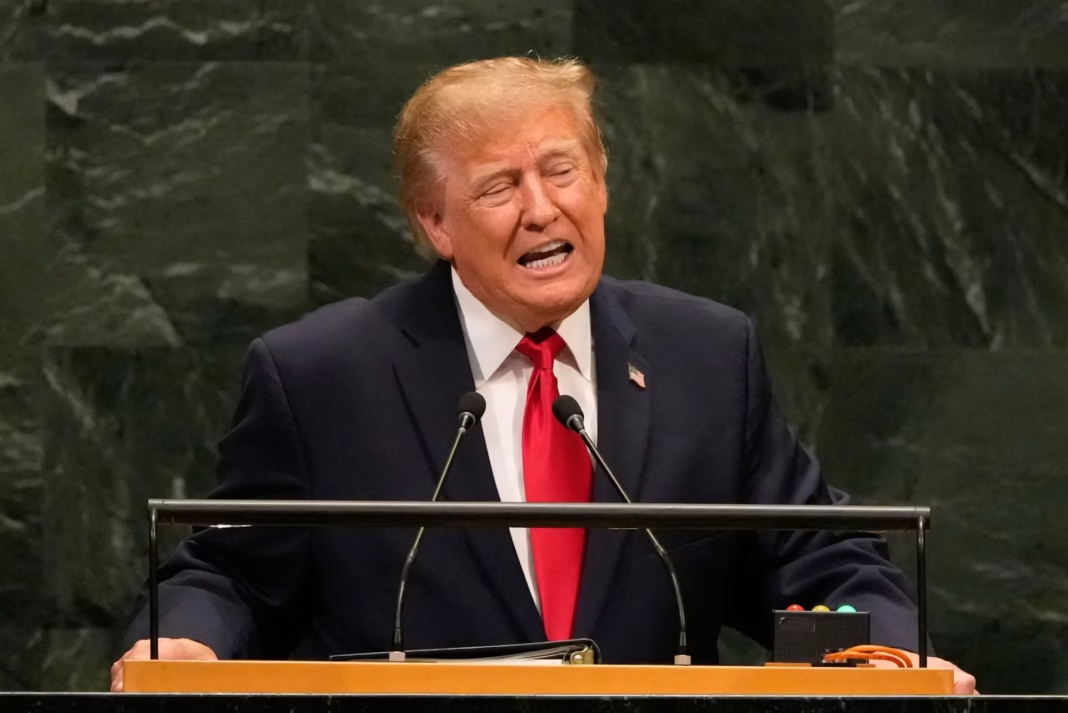
Speaking Tuesday at the 81st United Nations General Assembly in New York, Trump said the word “artificial” undersells the technology’s significance and said the United States would adopt the new terminology in government documents.
“From this point forward, all of United States documents, and hopefully the world’s, will be changed to use the much more accurate term Super as opposed to Artificial,” Trump said during his address.
Trump said the technology should henceforth be referred to as “superintelligence,” or “SI,” describing it as a major technological transformation that should not be constrained by regulation. “Every major new technology brings challenges, and Superintelligence is no exception,” he said.
The remarks came as governments and technology companies continue to weigh how to manage the economic, cybersecurity and national-security risks associated with increasingly capable AI systems.
Trump has repeatedly opposed calls for slowing AI development, arguing that stringent regulation could undermine U.S. competitiveness relative to China. “We’re leading China in AI, we’re the most sophisticated country in the world, and frankly I want to keep it that way,” he said earlier this month, responding to questions about calls for a development slowdown.
His administration has also taken steps toward a new AI-focused organizational structure. On Sept. 19, Trump announced plans to appoint an AI adviser an “AI czar” — and establish an “AI force,” though he did not detail how the structure would operate.
Tuesday’s comments extend a pattern of resistance to calls for additional federal safeguards. On Sept. 14, Trump described warnings about AI posing an existential risk as a “hoax” and criticized proposals for additional regulatory guardrails.
The broader debate has intensified as some technology executives and researchers have called for stronger safeguards around increasingly powerful AI systems. Separately, Reuters has reported that U.S. and Chinese officials have been working toward discussions on AI safety, including risks tied to AI-directed cyberattacks.
In his U.N. address, Trump argued that the United States should prioritize maintaining its technological lead over accepting international restrictions that could slow development. His position places Washington at the center of a broader debate over whether governments should prioritize rapid technological advancement or establish stronger international rules before AI capabilities progress further.
The proposed terminology change does not alter the underlying technology itself. “Artificial intelligence” remains the standard technical and scientific term used by governments, researchers and technology companies worldwide.
Trump acknowledged that “superintelligence” would also present challenges, while rejecting what he characterized as exaggerated warnings about AI posing a threat to humanity. “The very same people … are now saying that AI is going to kill us all, that robots are going to attack us, and that everything is going to be a total disaster,” he said.
The remarks come as the United States and China prepare for further discussions on AI, ahead of Trump’s expected meeting with Chinese President Xi Jinping, where technology and AI competition are expected to be among the topics discussed.