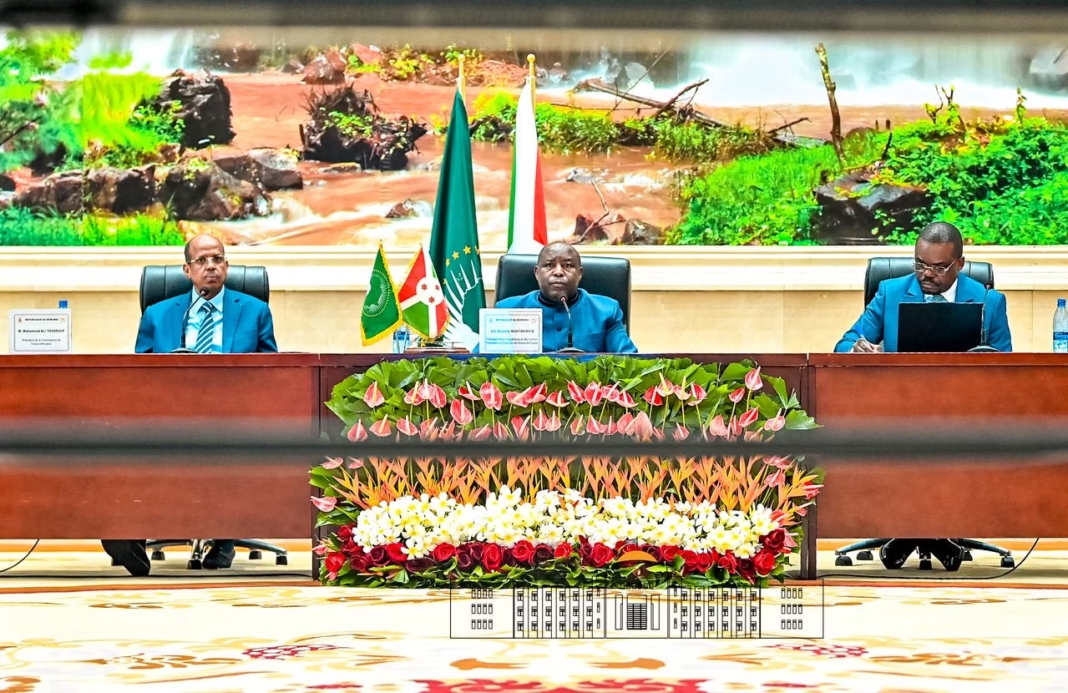

African leaders and international partners pledged support for the response to the growing Ebola outbreak in the Democratic Republic of the Congo and Uganda during a high-level virtual solidarity conference chaired by Burundian President Évariste Ndayishimiye in his capacity as current chairperson of the African Union.
According to the African Union, more than 500 participants from around the world joined the video conference, while representatives from 50 countries and partner organizations expressed solidarity and announced financial commitments to support efforts to contain the outbreak.
Addressing the meeting, Ndayishimiye warned that the epidemic had reached a critical stage, with more than 800 confirmed cases and nearly 200 deaths reported by June 15.
“No country can face a health crisis of this magnitude alone,” Ndayishimiye said, calling for African governments, the private sector and international partners to rapidly mobilize resources needed to implement a continental response plan coordinated by the Africa Centres for Disease Control and Prevention (Africa CDC) and the World Health Organization (WHO).
The joint Africa CDC-WHO response plan launched earlier this month seeks to raise $518 million to support surveillance, laboratory testing, treatment, infection prevention and emergency response efforts across affected and at-risk countries. The six-month plan is designed to strengthen preparedness and contain the spread of the virus under a unified “One Response” framework.
Ndayishimiye urged donors to convert pledges into immediate financial support.
“He urged African Governments, the private sector, and international partners to turn their pledges into actual funding to bolster surveillance, treatment, and prevention capacities in affected countries and those at risk of spread,” according to remarks released after the meeting.
The Burundian leader also cautioned against measures that could undermine the response effort.
“Science must guide our decisions, not fear,” he said, warning against unjustified border closures and travel restrictions while calling for stronger cross-border cooperation and support for frontline health workers.
“Africa is united, ready to act, and determined to protect its populations,” he added.
The appeal comes as health authorities warn that the outbreak, caused by the rare Bundibugyo strain of Ebola virus, is spreading rapidly in eastern Congo and has crossed into neighboring Uganda. Unlike the more common Zaire strain of Ebola, there is currently no licensed vaccine specifically approved for the Bundibugyo variant, complicating containment efforts.
Recent assessments by WHO and Africa CDC show confirmed cases and deaths increasing sharply in recent weeks. Health officials have reported ongoing transmission in several provinces of eastern Congo, while contact tracing, insecurity and community mistrust continue to hamper response efforts.
Speaking at the conference, African Union Commission Chairperson Mahamoud Ali Youssouf said the continent could not afford delays in responding to the outbreak.
“The fight against Ebola demands an immediate and unwavering response,” Youssouf said. “Every day lost translates to lives lost.”
He called for urgent funding to support intervention teams, strengthen disease surveillance systems, expand patient care and ensure access to vaccines, treatments and diagnostic tools under development.
Beyond the immediate emergency, Youssouf argued that the crisis highlights the need for Africa to build stronger public health systems capable of responding to future outbreaks.
He called for increased investment in scientific research, innovation and regional manufacturing of vaccines and diagnostic technologies to reduce dependence on external supply chains.
The African Union official also advocated strengthening national health systems through workforce training, expanded laboratory capacity, enhanced epidemiological surveillance and sustainable financing mechanisms.
“For him, saving lives today and strengthening Africa’s health resilience for tomorrow are two inseparable goals,” the AU said in a statement.
Health experts have warned that without stronger containment measures and sufficient funding, the current outbreak could become one of the most serious Ebola epidemics recorded on the continent. Africa CDC Director-General Jean Kaseya said this week that the outbreak risks becoming Africa’s worst Ebola crisis if transmission is not brought under control quickly.
The Ebola outbreak was first detected in eastern Congo in May and has since expanded across multiple health zones, prompting regional and international health agencies to intensify emergency operations. WHO and Africa CDC continue to classify the situation as a major public health threat requiring coordinated international action.