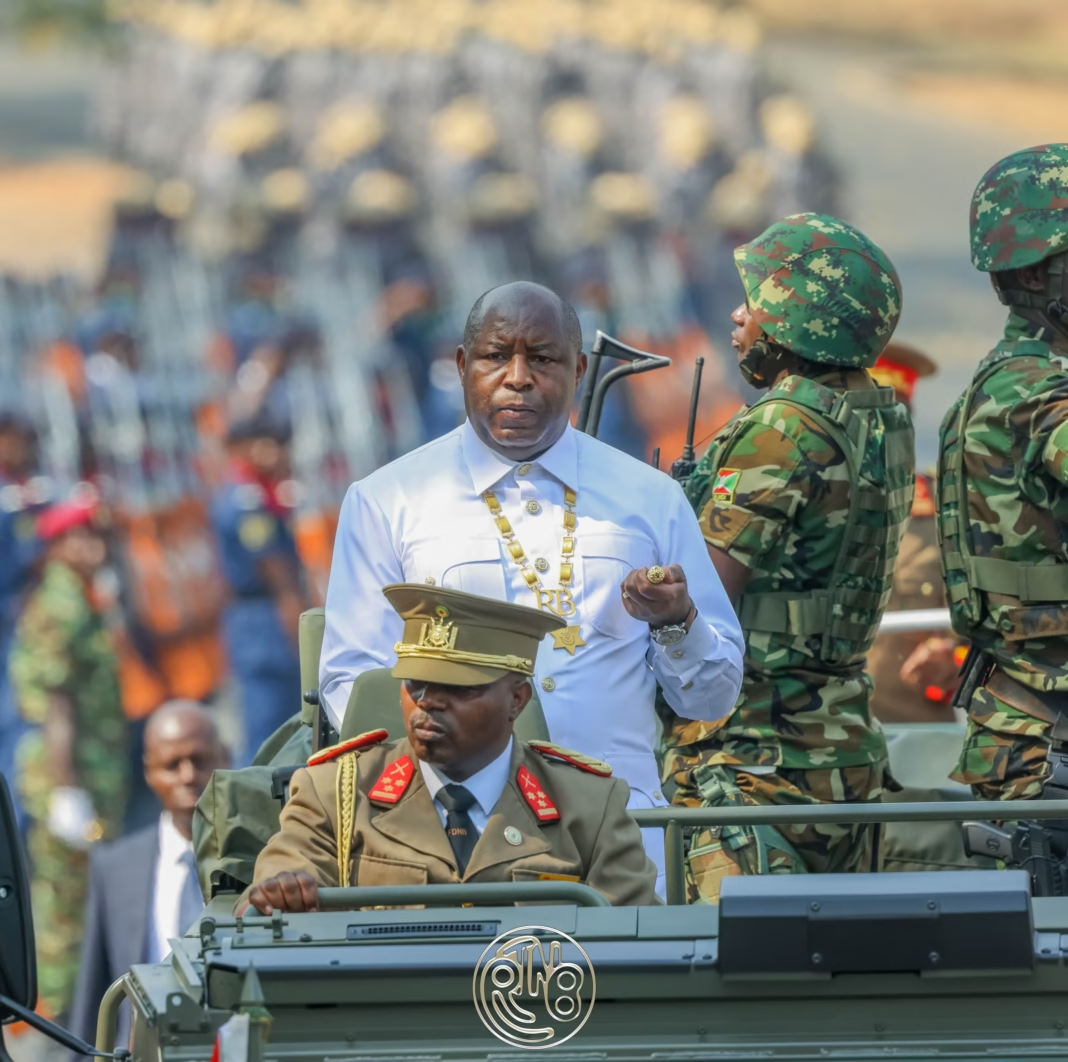
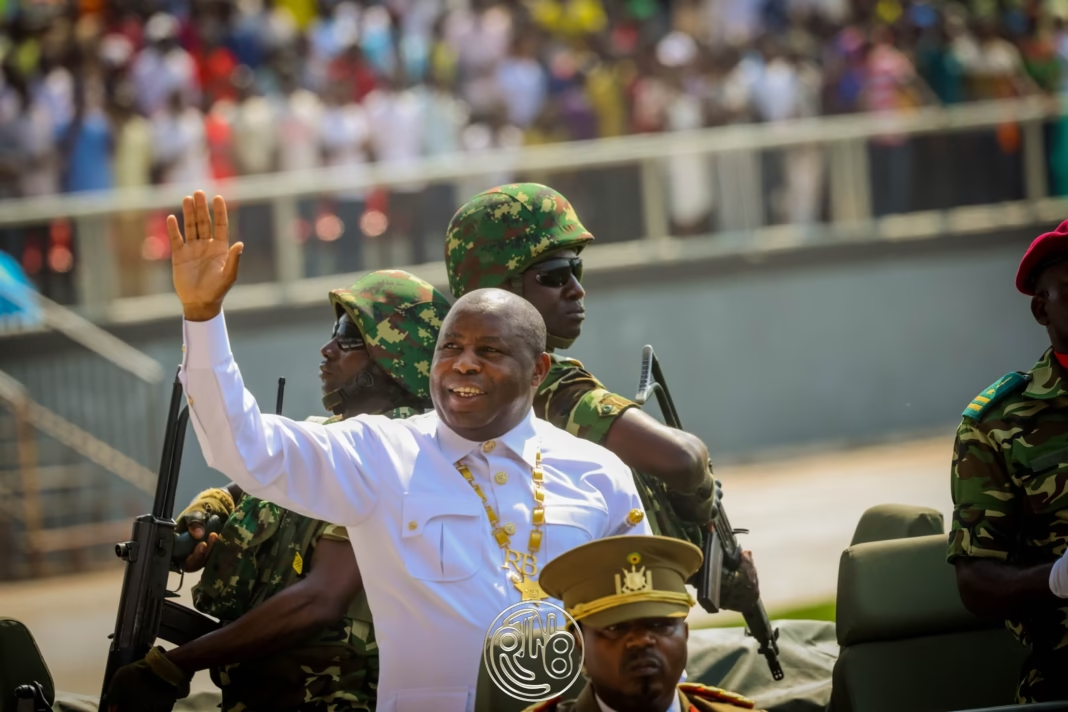

President Évariste Ndayishimiye used Burundi’s 64th Independence Day address on Wednesday to call for greater economic self-reliance and national unity, while making the unusual assertion that Rwanda should also commemorate Burundi’s independence because the liberation struggles of the two neighbouring countries were fought from Bujumbura.
Addressing the nation during celebrations marking Burundi’s independence from Belgium on July 1, 1962, Ndayishimiye said the country’s political sovereignty would remain incomplete without economic independence, urging Burundians to abandon dependence on foreign assistance and embrace domestic production, cooperatives and the exploitation of the country’s natural resources.
“True independence will only come when Burundians no longer look abroad for their survival,” Ndayishimiye said, calling on citizens to work toward the government’s long-term vision of making Burundi self-sufficient by 2040 and a developed nation by 2060.
The president framed economic transformation as the next stage of Burundi’s liberation, arguing that decades of colonial rule left behind not only political scars but also a culture of dependency that continues to shape national development.
“Our country no longer belongs to Germany or Belgium; it belongs to us, the Burundians,” he said. “We must build it ourselves just as other nations built theirs.”
Throughout the speech, Ndayishimiye urged Burundians to embrace hard work, entrepreneurship and cooperative farming, saying poverty could be overcome through production rather than reliance on external support.
“Poverty is not an incurable disease,” he said. “Those who refuse to work are the enemies of independence and development.”
The remarks reinforce a central theme of Ndayishimiye’s presidency, which has increasingly emphasized economic sovereignty alongside political independence. His administration has promoted agricultural modernization, mining and industrialization under the government’s Vision 2040 and Vision 2060 development agenda.
Burundi remains one of the world’s poorest countries despite recent economic growth, with much of its population dependent on subsistence agriculture. The government has identified mining, agriculture and regional trade as key drivers of future growth, although analysts say achieving the country’s long-term ambitions will require significant investment, improved infrastructure and continued governance reforms.
One of the speech’s most striking moments came when Ndayishimiye reflected on the shared colonial history of Burundi and Rwanda. During Belgian rule, Burundi and Rwanda were jointly administered as the territory of Rwanda-Urundi under a League of Nations mandate and later a United Nations trusteeship until the two countries gained independence separately on July 1, 1962.
Recalling that history, Ndayishimiye said the independence struggles of both countries were closely linked.
“Rwandans should, at the very least, come to Bujumbura and celebrate this day with us because the struggle for the independence of Rwanda and Burundi was fought in Bujumbura,” he said.
Historically, Bujumbura then known as Usumbura served as the administrative capital of Rwanda-Urundi during Belgian colonial rule and was an important political center in the years leading to independence. Nationalist movements from both territories operated during that period, although Burundi and Rwanda followed distinct political paths as they approached independence.
The comments come against the backdrop of a complex relationship between Burundi and Rwanda, whose governments have periodically accused each other of supporting armed groups operating across their shared border. Diplomatic relations have fluctuated over the past decade, though officials from both countries have taken steps toward improving cooperation in recent years.
Ndayishimiye devoted much of his speech to promoting patriotism and national ownership of Burundi’s economic future.
He argued that colonial authorities had discouraged Burundians from recognizing the country’s mineral potential and said the nation possesses abundant natural resources capable of transforming its economy.
“They still say Burundi is the poorest country in the world, yet they know God blessed us with mineral wealth,” he said.
Independent geological surveys have identified deposits of rare earth elements, nickel, gold and other strategic minerals in Burundi. The government has sought to expand mining activities as part of efforts to diversify an economy long dominated by agriculture, although the sector remains relatively underdeveloped.
The president also appealed to young people, describing them as Burundi’s greatest asset and urging them to embrace productive work rather than dependence.
“We must guide our youth toward activities that create wealth,” he said, encouraging greater participation in cooperatives and income generating enterprises.
Ndayishimiye further called on Burundians to reject ethnic divisions, arguing they were rooted in colonial policies that fractured a once-unified society. Historians generally agree that Belgian colonial authorities formalised ethnic classifications and introduced administrative policies that deepened social divisions in both Burundi and Rwanda, although scholars continue to debate the extent to which those policies alone explain subsequent conflicts.
The president said national unity and economic transformation must go hand in hand if Burundi is to realize its long-term ambitions.
“If we continue working together,” he said, “we will strengthen our political independence and our economic independence.” The speech capped nationwide celebrations marking 64 years since Burundi achieved independence, while underscoring the government’s continuing emphasis on economic self-reliance, patriotism and the unfinished task of translating political sovereignty into sustainable development.