

Regional leaders have approved a new financing model for the East African Community (EAC) that shifts the bloc toward an equity-based contribution system while granting a 50 percent waiver on accumulated arrears owed by partner states.
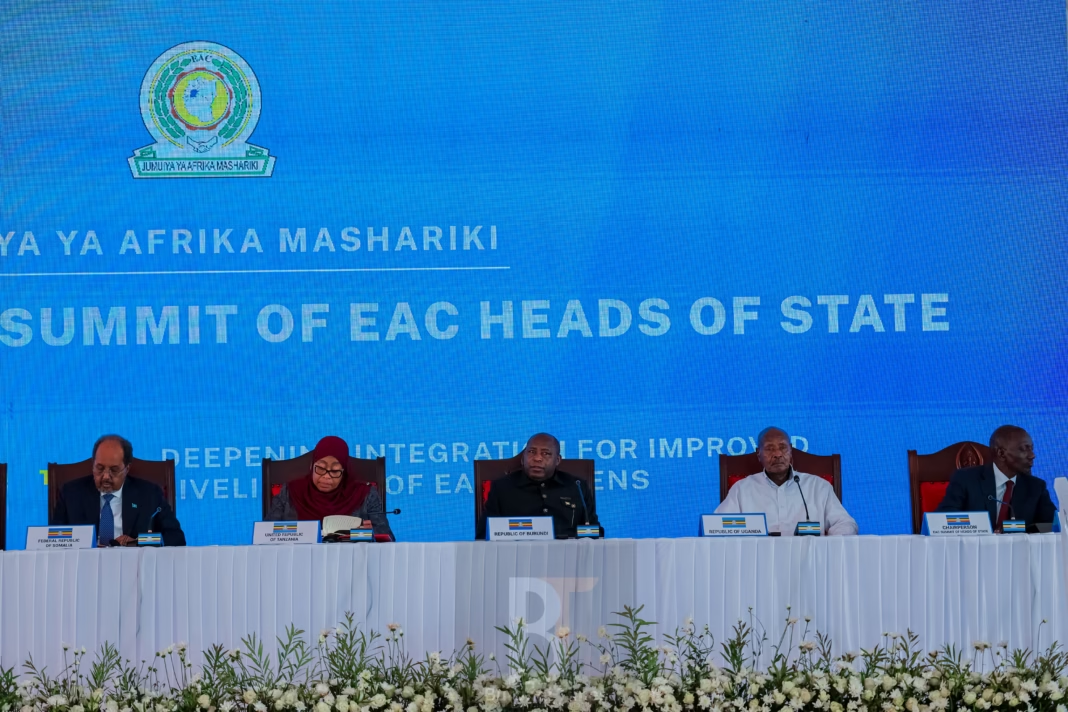
The decision was adopted during the 25th Ordinary Summit of the EAC Heads of State in Arusha, where Kenya’s President William Ruto handed over the chairmanship of the bloc to Uganda’s Yoweri Museveni.
The reforms are aimed at addressing persistent financial instability that has long plagued the regional organisation due to delayed or unpaid statutory contributions from member states.
In his final address as chairperson of the summit, Ruto acknowledged that the financial situation had become a major obstacle to the functioning of the Community.
“Delayed and non-remittance of statutory contributions to the EAC budget continue to hamper our ability to implement development projects and fulfil our collective commitments,” he told regional leaders.
“We made some consequential decisions and now going forward to make contributions to this community fair and equitable, the countries that have bigger economies and benefit more from the community should pay more,” said the Kenyan president during the summit in Arusha.
He warned that persistent arrears had undermined the organisation’s ability to deliver on its mandate.
“This challenge heavily undermines our financial sustainability, viability, and credibility as a regional organisation capable of delivering on our promises to our citizens,” Ruto said.
New equity financing formula
Under the new financing arrangement, EAC partner states will contribute to the bloc’s budget using a hybrid equity model.
The formula will see 50 percent of the budget contributed equally by all member states, while the remaining 50 percent will be assessed according to the economic strength of each country, largely measured through GDP and economic performance.
The move is intended to balance fairness with sustainability as the bloc expands and economic disparities between members widen.
Analysts say the system recognises that while integration requires shared responsibility, larger economies within the region have greater capacity to support regional institutions.
The EAC currently comprises eight partner states: Kenya, Tanzania, Uganda, Rwanda, Burundi, South Sudan, the Democratic Republic of Congo and Somalia.
50 percent arrears waiver
In a complementary move, leaders also approved a 50 percent waiver on outstanding arrears owed by member states, with the remaining balance expected to be settled within an agreed timeframe.
The measure is designed to reset the financial relationship between the EAC Secretariat and partner states while restoring the bloc’s operational stability.
Over the years, delayed remittances have forced several EAC organs — including legislative and administrative institutions — to scale down activities due to budget constraints.
Ruto used the summit to urge partner states to prioritise financial discipline moving forward.
“It is therefore our noble duty to honour our respective financial obligations to the Community promptly, to build a resilient, credible, and fully equipped Community capable of delivering on the aspirations of our people,” he said.
Integration gains highlighted
Despite the financial challenges, Ruto said the Community had made notable progress during his tenure.
He cited significant growth in regional trade, revealing that intra-EAC trade rose by nearly 22 percent from $33 billion in 2024 to $40.3 billion in 2025.
“Trade among partner states has continued to register positive growth,” he said, noting that exports from the region increased sharply while imports rose more moderately.
He also reported progress in addressing barriers that have historically slowed regional trade.
“Our concerted efforts to eliminate non-tariff barriers have yielded results, with the number of reported barriers declining by about 56 percent,” Ruto said.
Infrastructure development across key transport corridors, expansion of rail networks and increased digital integration were also highlighted as major achievements during Kenya’s chairmanship.
With the bloc continuing to expand geographically and economically, regional leaders say sustainable financing will be essential to maintaining momentum in the integration agenda.