
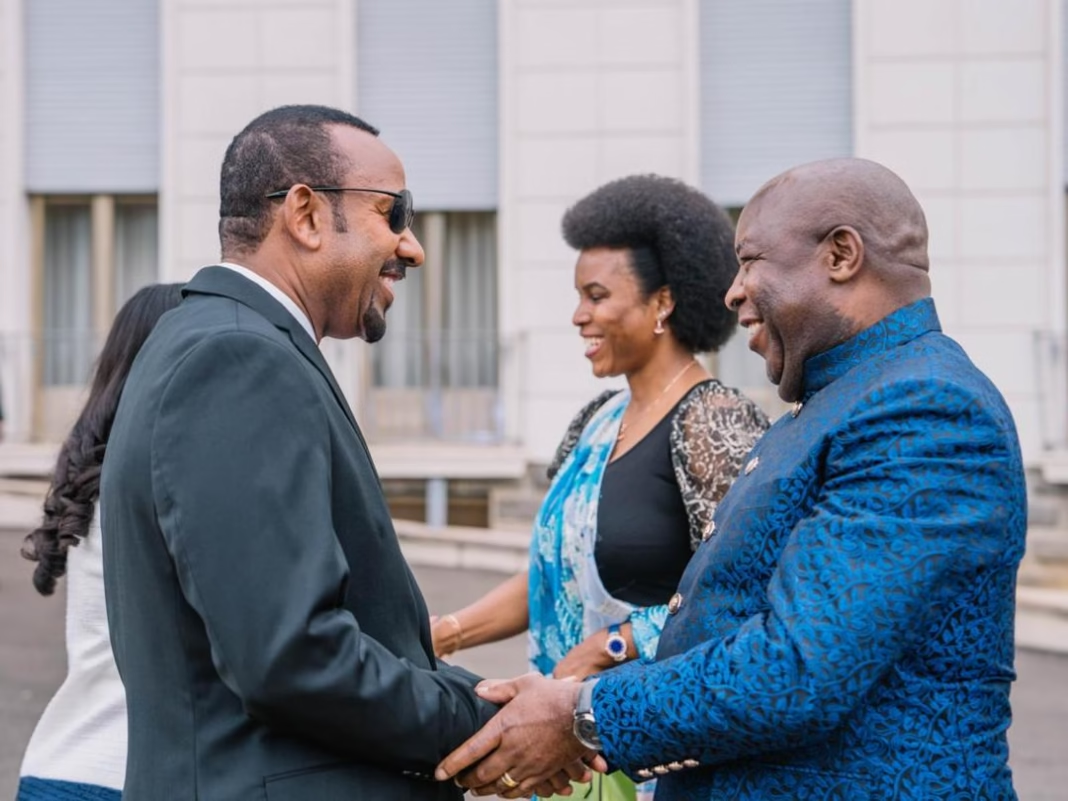

Burundi is seeking to unlock trade and investment opportunities through new agreements with Ethiopia, as officials acknowledge that economic ties between the two countries remain significantly underdeveloped despite growing diplomatic alignment.
Évariste Ndayishimiye and Abiy Ahmed this week oversaw the signing of several Memoranda of Understanding (MoUs) covering trade, transport, agriculture, energy, education, health, tourism and digital development, according to official statements.
The agreements were concluded alongside the Second Ethiopia–Burundi Joint Ministerial Commission (JMC), aimed at translating political relations into concrete economic outcomes.
While both governments highlight strong political relations, available data shows Burundi’s trade remains heavily concentrated within the East African Community (EAC), with limited direct exchange with Ethiopia.
According to regional trade profiles compiled by the United Nations Conference on Trade and Development (UNCTAD) and World Bank:
- Burundi’s exports are dominated by coffee and tea, accounting for the majority of foreign earnings
- Its main trading partners are countries such as Tanzania, the Democratic Republic of Congo and Kenya
- Trade with non-EAC African economies, including Ethiopia, remains marginal or statistically insignificant in available datasets
The Bank of the Republic of Burundi does not publish detailed bilateral trade breakdowns with Ethiopia in its latest public reports, reflecting the low volume of direct trade flows.
For Burundi, the new agreements signal a broader strategy to diversify economic partnerships beyond traditional regional corridors.
Ethiopia one of Africa’s largest economies with a population exceeding 120 million offers potential opportunities in:
- Market access for Burundian exports
- Industrial and agricultural cooperation
- Technology and digital development
- Air and logistics connectivity
Ethiopia’s foreign minister, Gedion Timothewos, acknowledged the gap between political and economic ties.
“The success of the commission should be measured by the effective implementation of agreed initiatives,” he said.
Burundi’s foreign minister, Édouard Bizimana, said the agreements are designed to deliver tangible outcomes.
“The commission serves as a vital platform to translate shared commitments into concrete projects,” he said.
Structural barriers to trade
Analysts point to several factors limiting trade between the two countries:
- Geographic distance without direct transport corridors
- Burundi’s reliance on Dar es Salaam port routes
- Limited air cargo and logistics connectivity
- Overlapping export profiles (especially in agriculture)
The new MoUs, particularly in transport and infrastructure, are expected to address some of these constraints over time.
The agreements also carry strategic weight. Burundi currently chairs the African Union, while Ethiopia hosts its headquarters in Addis Ababa.
Closer cooperation could strengthen alignment on:
- African Continental Free Trade Area (AfCFTA) implementation
- Regional peace and security
- Economic integration policies
Prime Minister Abiy Ahmed framed the agreements as a step toward deeper cooperation.
“These discussions and the resulting agreements are… the foundation for transforming our long-standing ties into tangible cooperation,” he said.
The revival of the Joint Ministerial Commission first held in 2014 and reconvened in 2026 marks the most structured effort in recent years to formalise relations between the two countries.
However, the newly signed agreements remain framework MoUs, meaning their impact will depend on implementation.
For Burundi, the challenge will be turning diplomatic engagement into measurable economic gains, particularly in increasing exports, attracting investment and integrating into broader African markets.