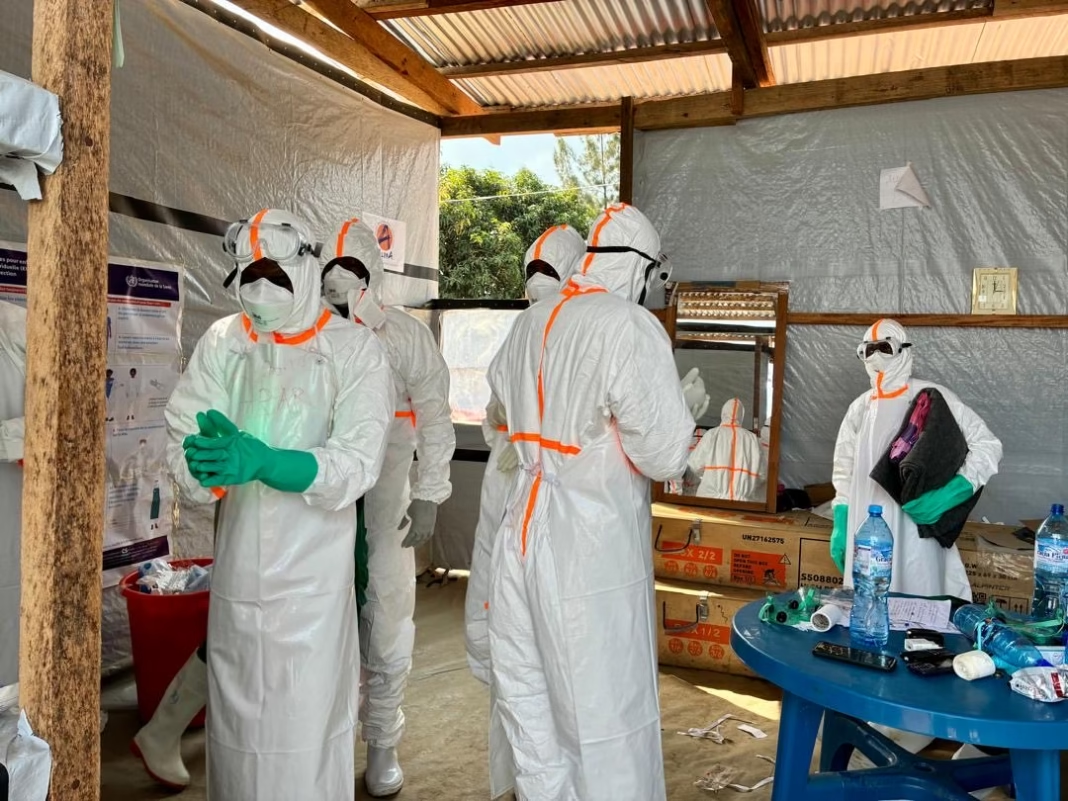

More than 2,000 people have died from confirmed Ebola infections in the Democratic Republic of Congo, with half of those deaths recorded in the past 20 days, as the country confronts one of the fastest-moving Ebola outbreaks ever recorded.
The provisional toll, based on the latest data from Congolese health authorities and cited by a senior United Nations official, makes the current outbreak the second-deadliest Ebola epidemic in history.
“Today, the Ebola outbreak has surpassed 2,000 deaths, half of them in the last 20 days,” Julien Harneis, the U.N. senior Ebola coordinator, said on X. “2,000 children, mothers, fathers. As many individual tragedies.”
Health authorities reported 4,381 confirmed Ebola cases and 2,011 deaths as of the latest update, compared with 4,294 confirmed cases and 1,960 deaths reported Aug. 8.
The case fatality rate stands at 45.6%, while 722 patients are currently hospitalized or in isolation. A total of 849 people have been declared recovered since the outbreak began.
The outbreak was officially declared May 15 in eastern Congo and has since spread across five provinces: Ituri, North Kivu, South Kivu, Haut-Uele and Tshopo.
According to health authorities, 53 of the country’s 140 health zones and 246 health areas are currently affected.
Ituri remains epicenter
Transmission remains active in Ituri, which is the epicenter of the outbreak, as well as in North Kivu and Haut-Uele.
South Kivu, however, has recorded no new confirmed case for 73 days, according to the latest health data.
The speed of the outbreak has raised concern among health officials and humanitarian agencies.
It took about nine weeks for the outbreak to reach 1,000 deaths. The next 1,000 deaths were recorded in roughly three weeks.
That acceleration has placed additional pressure on already strained health services in areas affected by conflict and limited access to health care.
“We are all engaged in the response, alongside communities — humanitarian workers, organizations, governments and donors, alongside the populations — and we must do more, and act today, to save lives and end Ebola,” Harneis said.
Outbreak likely began months before detection
The World Health Organization said Monday that the outbreak likely began in February, almost three months before it was officially declared.
The delayed detection appears to have contributed to the spread of the virus.
According to WHO, some patients were initially diagnosed with malaria or typhoid, while early testing focused on the more common Ebola virus species rather than the Bundibugyo virus responsible for the current outbreak.
“We are therefore chasing the virus, but it has a head start on us,” said Dr. Mohamed Janabi, WHO regional director for Africa.
The Bundibugyo virus is a relatively rare Ebola species. Unlike some other Ebola virus species, there is currently no approved vaccine or treatment specifically for Bundibugyo Ebola.
Clinical trials have nevertheless begun in Ituri as health authorities and international partners seek new tools to control the outbreak.
The combination of delayed detection, armed conflict and overwhelmed health facilities has contributed to a faster spread than seen in several previous Ebola outbreaks, according to WHO.
Second-deadliest Ebola outbreak
The current outbreak is the 17th recorded Ebola outbreak in Congo and has already become the second-largest in terms of deaths.
The deadliest remains the 2014-2016 West Africa Ebola epidemic, which recorded 28,616 cases and 11,310 deaths across Guinea, Liberia and Sierra Leone.
The pace of the current outbreak is particularly concerning. During the West Africa epidemic, it took nearly five months after the outbreak was declared to reach 1,000 deaths. In Congo, the current outbreak reached 2,000 deaths in about three months.
Despite the rapid progression, WHO says there have been some advances in the response.
“We need to do more, and we will,” Janabi said. “With our partners and the Congolese government, urgent and collective action is essential to end this outbreak.”
The continuing transmission in parts of eastern Congo also raises concerns for neighboring countries, where population movements and cross-border trade can complicate efforts to contain infectious disease outbreaks.