
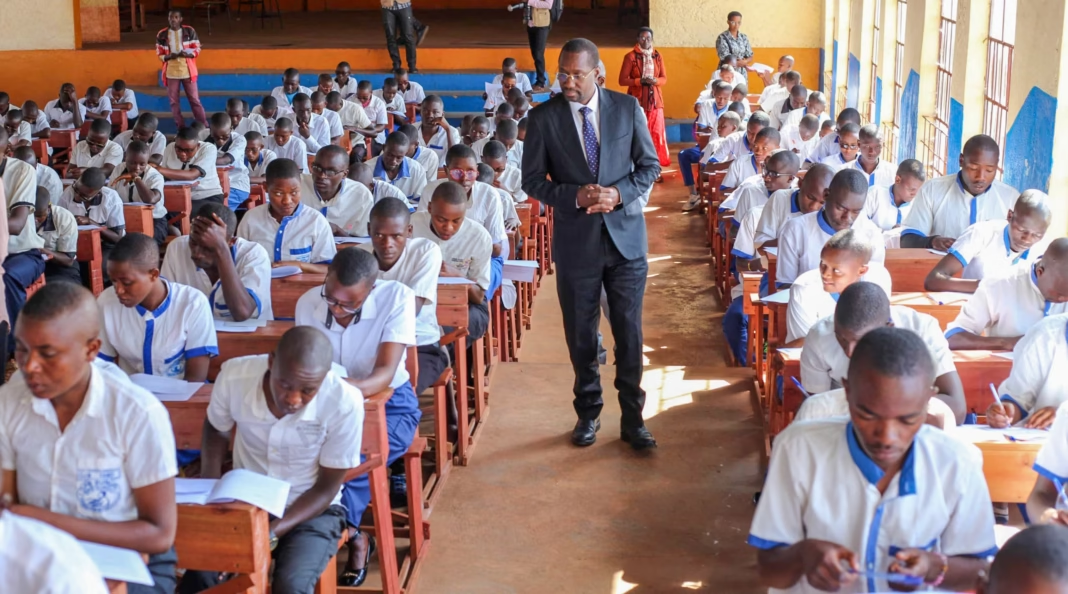

As East African governments push to build a borderless education system, one divide is proving especially difficult to bridge: language.
Burundi, which joined the East African Community in 2007, runs a predominantly French-speaking higher education system, while most of its EAC neighbors conduct university instruction largely in English. That gap complicates efforts to align curricula, transfer academic credit and recognize qualifications across the bloc — one of several obstacles officials acknowledged this week as they gathered in Nairobi to assess progress on the EAC’s decade-long push for regional education integration.
More than 600 education leaders, policymakers and other stakeholders from the EAC’s eight partner states convened in the Kenyan capital for the bloc’s second regional education conference, a four-day event reviewing progress made since a first gathering in Arusha, Tanzania, in 2024.
Kenya’s Cabinet Secretary for East African Community and Arid and Semi-Arid Lands, Beatrice Askul Moe, told delegates that regional integration must not come at the cost of a student’s education.
“As regional integration deepens, our systems must become more interoperable,” Askul Moe said at the conference’s opening. “A child moving between partner states should not have their education interrupted because they crossed a border.”
The EAC has worked for years to make academic qualifications comparable across the region and to ease the movement of students, academics and workers. Its Common Higher Education Area, established in 2017, calls for mutual recognition of qualifications and greater student and labor mobility.
Progress, however, has been gradual. According to the EAC’s own data, the number of student passes issued by partner states to all nationalities climbed from 23,537 in 2021 to 39,786 in 2024. But the share of those passes going to EAC nationals — as opposed to students from outside the bloc — rose only slightly, from 29% in 2021 to 35% in 2022, before holding steady at 35% through 2024.
Officials at the conference pointed to several obstacles slowing deeper integration, including teacher shortages, resource constraints, weak transitions between education levels and differences in national curricula.
Ariik Malueth, the EAC’s deputy secretary general for productive and social sectors, said the bloc has developed a regional framework to standardize technical and vocational qualifications and align training with labor market needs across the region. That framework, he said, is still awaiting formal approval.
“These initiatives demonstrate that regional cooperation in education is already producing practical frameworks,” Malueth said. “Our responsibility now is to ensure that these frameworks translate into better learning, stronger institutions, relevant skills and greater opportunities for East Africans.”
The bloc’s Inter-University Council for East Africa runs mobility programs for students and staff across member states. In July, the council opened applications for its 2026-27 Student Mobility Scheme, which allows EAC nationals to pursue undergraduate and graduate studies in another partner state.
But a 2025 IUCEA publication, which drew on input from Burundi’s higher education regulator, found that language differences, uneven tuition policies and difficulty getting qualifications recognized across borders remain persistent barriers to academic integration.
That language divide remains one of the clearest examples of how far the region still has to go to make its education systems interoperable, officials say.
The EAC’s Common Market Protocol is intended to allow workers from one partner state to take jobs in another without discrimination based on nationality, subject to national rules and exceptions. But officials say that promise depends on qualifications earned in one country being recognized in another — a question the region has yet to fully resolve.
The Nairobi conference is expected to produce a roadmap laying out commitments, priority initiatives and timelines for the next phase of the EAC’s education integration push.
Askul Moe told delegates that any curriculum overhaul would need to be matched by investment in teachers.
“Curriculum transformation without teacher transformation cannot succeed,” she said. “As a region, we should regard our teachers not simply as employees of national systems, but as a community of East African professionals.”
Whether the conference succeeds, officials and analysts say, will depend less on the commitments announced this week than on whether a student can move from Bujumbura to Nairobi, Kampala or Dar es Salaam and find the seamless system policymakers have long promised.