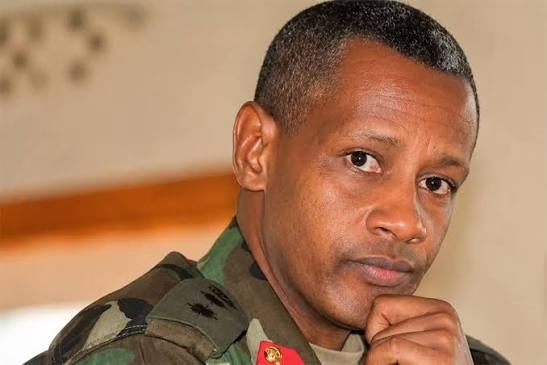


Tanzania’s ruling Chama Cha Mapinduzi (CCM) has expelled Vice President Emmanuel Nchimbi from the party, a day after he announced he would resign from government and retire from politics altogether an abrupt rupture at the top of the country’s leadership.
CCM Secretary-General Asha-Rose Migiro announced the expulsion Wednesday following an emergency meeting of the party’s senior organs in Dar es Salaam, saying Nchimbi had been removed for breaching the party’s rules on discipline and ethics. “He is expelled from party membership,” Migiro told reporters, adding that the decision was unanimous.
The party simultaneously endorsed Energy Minister Deogratius Ndejembi, 43, as its nominee to succeed Nchimbi. Ndejembi, the CCM member of parliament for Chamwino, will need parliamentary approval before he can be sworn in.
A resignation that stunned Tanzania
Nchimbi, 54, announced his resignation on Instagram on Tuesday, saying it would take effect Sept. 4. He said he had privately promised President Samia Suluhu Hassan the previous year that he would step aside if she wanted a different running mate, and that he had since become convinced she did. He pledged to remain “a good citizen” of Tanzania after leaving office. President Hassan accepted the resignation, and constitutional procedures to appoint his successor are now underway.
The move was unprecedented: Nchimbi, sworn in on Nov. 3, 2025, becomes the first vice president in Tanzania’s history to resign from the post. His departure came after less than a year in office and just weeks after he had publicly urged Tanzanians to push for a new constitution, framing reform as essential to protecting human rights and strengthening democratic governance remarks that reportedly drew criticism within CCM and fueled speculation about a rift with Hassan. Local media reports on the mounting pressure over his position had already led to at least one outlet being suspended in the run-up to his announcement.
His expulsion from the party less than 24 hours later on top of a resignation and stated retirement from politics — added a further, unusual dimension to his exit.
Reading between the lines
Tanzanian officials have not publicly detailed the reasoning for Nchimbi’s departure beyond the formal process, and CCM has cited only “discipline and ethics” violations for the expulsion. But the Associated Press reported that the party’s move was widely viewed as an act of retaliation, and that analysts have linked the fallout to tensions between Nchimbi and Hassan over governance and the government’s handling of the unrest that followed last year’s election.
That election, held Oct. 29, saw Hassan win with nearly 98% of the vote after leading opposition figures were disqualified from the race; the main opposition party, Chadema, boycotted in protest, having called for electoral reforms as a precondition for taking part. The disqualifications and boycott were followed by protests that were met with a security crackdown. A government-appointed inquiry found that at least 518 people were killed in the violence.
What comes next
The immediate task is filling the vice presidency: Ndejembi’s nomination now goes to parliament, which must approve him before he can be sworn in.
But the larger story is what Nchimbi’s resignation and expulsion suggest about the state of Tanzania’s political establishment. CCM has governed the country since independence in 1961, and its dominance has long been associated with continuity and stability including the smooth transition that followed President John Magufuli’s death in office in 2021. A vice president resigning, retiring from politics, and being expelled from the ruling party within the space of two days is a marked departure from that pattern, and is likely to keep questions swirling over the tensions inside CCM’s leadership as the country continues to reckon with the aftermath of last year’s election.