
Burundi’s police on Tuesday presented a Rwandan national whom authorities say was recruited by the RED-Tabara armed group in eastern Democratic Republic of Congo, part of a renewed push by the government to link Rwanda to the movement.
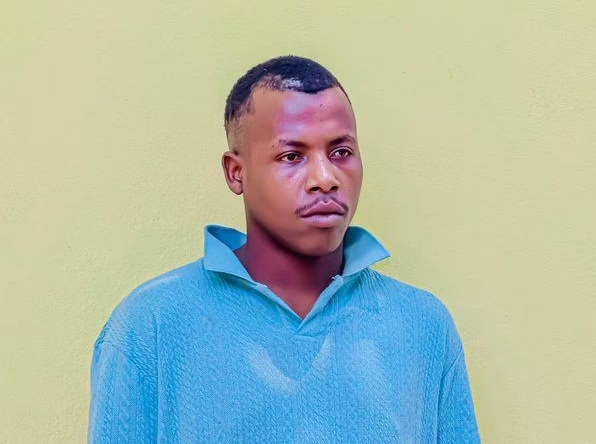
The man, identified as Bonheur Dieudonné, appeared before reporters in Bujumbura on Sept. 1. Authorities said he was arrested in eastern Congo after allegedly joining RED-Tabara. The claims could not be independently verified, and authorities offered no public evidence beyond his own account to establish that he fought for the group or that Rwanda’s government played any role in his recruitment.
Dieudonné, identified as a Rwandan born in 1999 and from Nyamagabe district in Rwanda’s Southern Province, described his path from Rwanda to eastern Congo. He said he had gone to Kigali looking for work, where he met a man identified only as Rwigema, who took him to the Gicukiro area. There, he said, he found a large group already gathered at a house; roughly 50 people, including him, were later moved to Kabuga and merged with about 100 others.
After two weeks, he said, the group was taken to Bukavu and then to Kaziba, in South Kivu where he said, they were issued military boots and met RED-Tabara fighters. He said the group later came under attack from Wazalendo militia fighters. Some fled and hid for days in the hills around Kajinja before surrendering to the Wazalendo, who handed them to the Congolese army. Congolese forces then transferred them to Burundian custody, according to his account.
Rwandan nationality called significant
Pierre Nkurikiye, spokesman for Burundi’s Ministry of Interior, Community Development and Public Security, said authorities had previously arrested people in eastern Congo over alleged RED-Tabara ties but called this detainee’s Rwandan nationality new.
“What is new in this case is that among these people there is a Rwandan,” Nkurikiye said, according to the government’s account of the briefing.
Burundi argues the case bolsters its longstanding claim that Rwanda supports RED-Tabara, which has claimed attacks inside Burundi. Nkurikiye also alleged Rwanda provides military and weapons training to recruits, and said the group has built a network of Burundians and Rwandans aimed at destabilizing Burundi and forcibly overthrowing its institutions.
He named opposition figure Alexis Sinduhije and journalist Bob Rugurika as people authorities link to that network. No independent evidence was presented at Tuesday’s briefing to support that either man belongs to RED-Tabara or is involved in a plot against the government, these remain allegations. Rwanda has consistently denied backing armed groups seeking to destabilise Burundi.
Two soldiers accused over contact with journalist
Authorities also presented two Burundian soldiers accused of exchanging information with Rugurika about alleged destabilisation activity. The government said the soldiers were arrested Aug. 25 in Bujumbura on suspicion of passing along information usable in a destabilisation plot, and alleged Rugurika had sought details on military personnel and troop locations. None of the accusations against Rugurika have been tested in court, and it remains unclear whether formal charges have been filed against the soldiers.
In a post on X following the presentation, Rugurika rejected the government’s account, calling it a fabrication meant to damage his reputation and describing the allegations as a contrived affair. He said he believed the truth would eventually emerge.
A long-running dispute
The arrests land against years of tension between Gitega and Kigali, with each government accusing the other of backing hostile armed factions. Rwanda has repeatedly denied supporting RED-Tabara. The dispute also plays out against the broader war in eastern Congo, where RED-Tabara has operated alongside other armed groups whose presence has been documented by the U.N. and other international monitors.
That documentation, however, stops short of establishing individual guilt or drawing a line from an armed group’s actions to a neighboring government’s policy.
For now, Dieudonné’s account gives Burundi’s government another data point in its case against Rwanda, but the central claims about his recruitment and his ties to RED-Tabara remain unverified by anyone outside the government. Rwanda’s government had not responded publicly to the latest accusations as of publication.