
UNITED NATIONS — Burundi’s ambassador to the United Nations, Zéphyrin Maniratanga, called on the UN General Assembly Wednesday to formally recognize the 1972 genocide against the Hutu population, a campaign of state-sponsored killings that left hundreds of thousands dead.
Speaking at the 80th plenary meeting focused on the Responsibility to Protect (R2P), Maniratanga said, “Between April and July 1972, hundreds of thousands of Burundian Hutus were hunted, arrested, executed without trial, and often buried in mass graves. The victims were not killed for what they had done, but for who they were.”
Estimates of the death toll during this period range from 200,000 to 300,000, with some sources placing the number between 100,000 and 210,000. The killings followed a Hutu rebellion that began on April 29, 1972, prompting violent reprisals from the Tutsi-led government, according to Burundi’s and Reconciliation Commission (CVR).
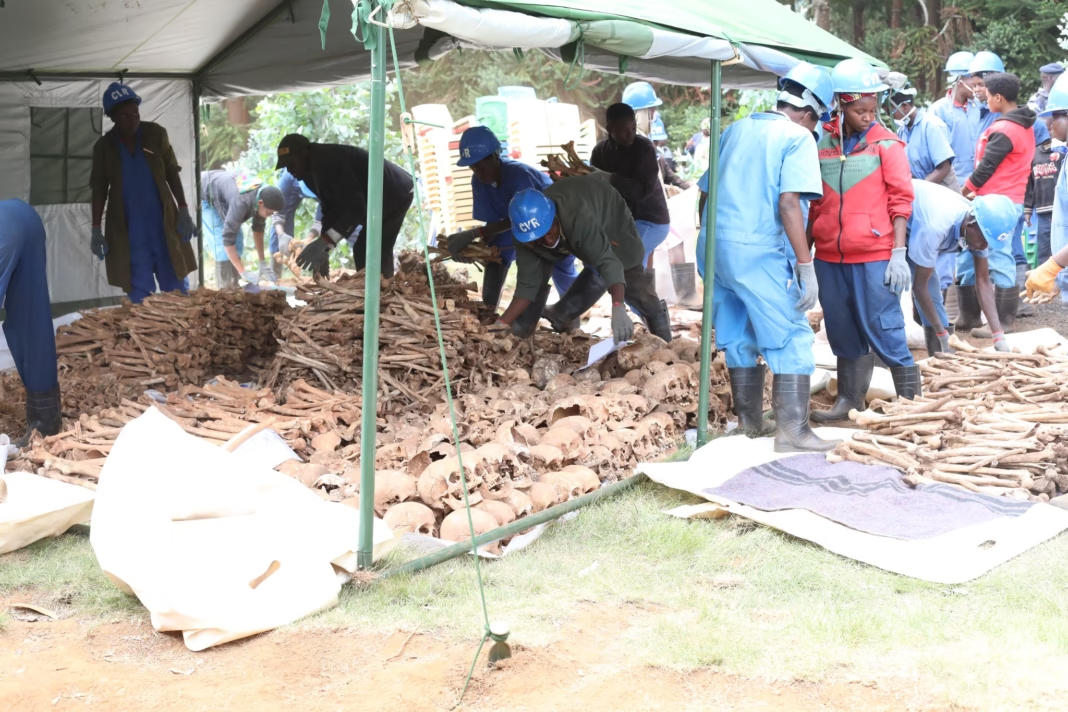
For decades, the killings were not formally labeled genocide. In December 2021, the CVR officially classified the atrocities as genocide, citing the discovery of more than 4,000 mass graves and thousands of testimonies, along with forensic evidence.
Maniratanga emphasized that despite the CVR’s findings, “no resolution of this Assembly, no Security Council report, no memorial space” has acknowledged the genocide. He called this silence “not neutral” and said it abandons the victims who “deserve peace.”
The 1972 massacre, locally known as the Ikiza or “Catastrophe,” began after a Hutu-led uprising was violently suppressed by the government of then-President Michel Micombero. The campaign targeted Hutu intellectuals, students, teachers, civil servants, and even children, with estimates of up to 300,000 killed and roughly 300,000 Hutu fleeing as refugees.
In his address, Maniratanga made five key requests to the UN:
- Formal recognition of the 1972 genocide based on the CVR’s conclusions.
- Inclusion of the genocide in educational materials on 20th-century atrocities.
- Creation of a memorial space at UN Headquarters to honor the victims.
- Support for Burundi’s transitional justice and reparations efforts.
- Use of the 1972 genocide as a training case in UN genocide-prevention programs.
“How can we pretend to prevent tomorrow’s atrocities if we are unable to confront yesterday’s?” Maniratanga asked. He said the silence on the genocide is “a flaw in our collective prevention architecture.”
The CVR was established in 2014 under the 2000 Arusha Peace Agreement and extended through 2022. Its mandate covered investigations of mass atrocities from Burundi’s independence in 1962 through the genocide period and beyond. The commission exhumed graves, conducted field hearings, and analyzed archival records.
While many Burundians view UN recognition as critical for healing and reconciliation, some political factions have disputed the genocide label or aspects of the CVR report.
Maniratanga concluded by warning that ignoring the crime risks betraying the UN’s core principles. “A people who mourn their dead in silence, in oblivion, in denial by the world, is never truly at peace… By recognizing the 1972 genocide, we are not rewriting history — we are completing it.”
Key facts:
- Estimated death toll: 200,000 to 300,000 Hutus killed during 1972 atrocities.
- More than 4,000 mass graves documented by Burundi’s CVR.
- CVR mandate covered the period from 1962 to 1993.