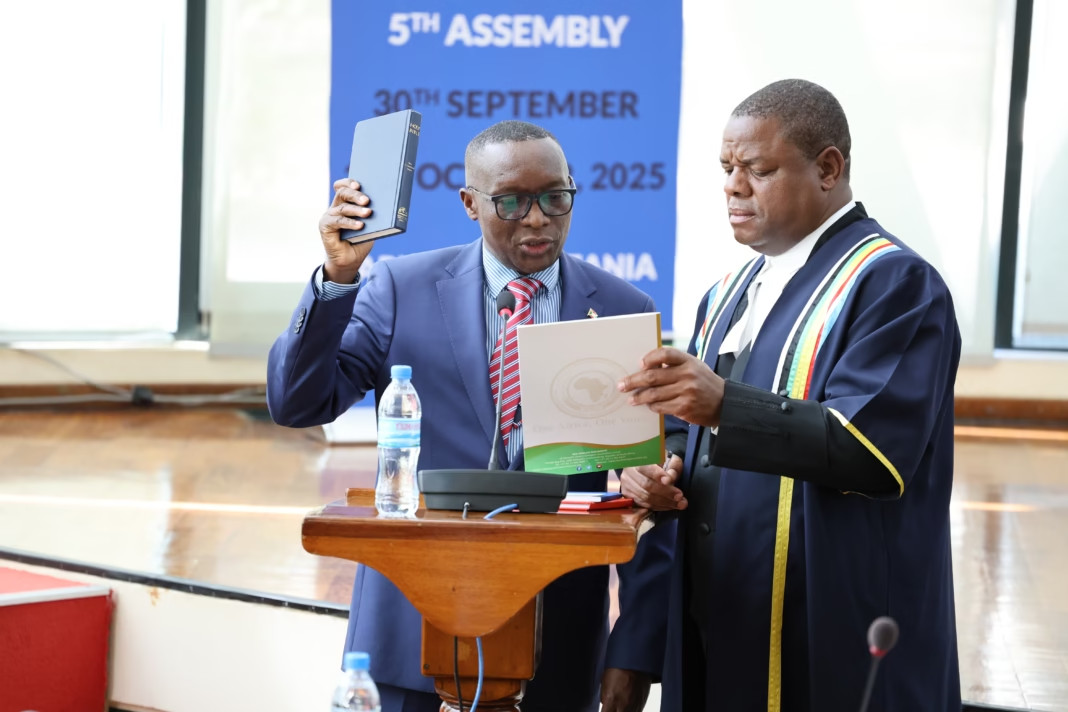

ARUSHA, Tanzania — The East African Legislative Assembly (EALA) has sounded alarm over persistent governance failures, mineral smuggling, and inconsistent mining laws that are draining billions in potential revenue from the region’s mineral wealth.
In a report adopted Tuesday by EALA’s Committee on Agriculture, Tourism and Natural Resources (ATNR), lawmakers said the mining sector remains “underperforming due to weak regulatory frameworks, corruption, slow licensing processes, and unpredictable tax regimes.”
The committee, which conducted an oversight mission across East African Community (EAC) partner states from September 16 to 20, 2025, found that while the region is rich in gold, rare earth elements, and industrial minerals, the benefits are not reaching citizens equitably.
“Mining is a significant contributor to national GDPs, but the benefits are often not equitably distributed,” the report said. “Poor roads, unreliable energy, and limited water supply continue to hinder sector growth.”
The report also cited widespread environmental degradation and poor mine rehabilitation practices across the EAC. It urged partner states to develop land restoration plans and adopt digital traceability systems to stop mineral smuggling.
Among its key recommendations, EALA called on the EAC Council of Ministers to harmonize regional mining regulations, develop an EAC Mining Protocol, and establish a regional Centre of Excellence for mineral research and mapping.
“Partner States should foster political stability, practice good governance, and establish predictable tax regimes to attract long-term investment,” said Gideon Gatpan EALA law maker from South Sudan.
The report noted that inconsistencies in mining regulations across member states have created loopholes exploited by smugglers and investors who take advantage of varying national laws. EALA urged the EAC Secretariat to “initiate the process of harmonizing mining policies and regulations” and to develop strategies that encourage cooperation in managing the sector.
“Partner States must invest in technology and innovation, including digital tracking and traceability systems, to stop cross-border smuggling of minerals,” the report added.
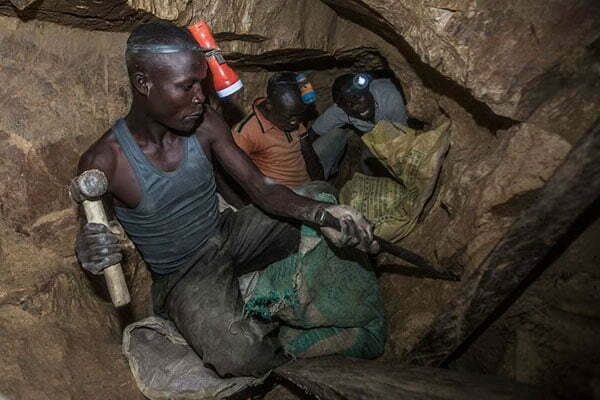
EALA members also called for more support to artisanal and small-scale miners through training, financing, and formalization to boost productivity and safety.
Tanzania, one of the region’s top mineral producers, loses significant revenue through gold smuggling and illicit trade. According to a 2025 investigation, nearly 90 percent of artisanal miners in some areas operate outside legal frameworks, with weak border controls and under-declared exports costing the country millions.
“If we look at the mining statistics contribution like 1% of the GDP in Kenya, Tanzania 10% which is the highest in the region, Uganda 2.2%,” said Saidi Kibeyi EALA member from Burundi.
A recent Africa Governance Report (AU/APRM, 2025) found that local communities in Kenya, Tanzania, and the Democratic Republic of Congo are often under-compensated. It noted that “inequitable distribution of mining revenue, weak contract transparency, and poor oversight undermine trust and fuel conflicts.”
Experts estimate that EAC countries lose as much as US$1.6 billion annually due to smuggling and tax loopholes driven by fragmented mining laws and porous borders. Analysts argue that aligning tax and regulatory systems could help recapture lost revenue and strengthen investor confidence.
“East Africa and Africa in general have been blessed with underground resources and minerals that are very rare. But they are far from being a blessing and have become a terrible curse in our region.The region that has minerals are synonymous with poverty, and sometimes civil war,” said David Sankok EALA member from Kenya.
In Tanzania, local content gaps and inconsistent enforcement remain major obstacles to capturing full value from mining. Although the sector contributes about 10 percent of GDP and more than half of foreign export earnings, profits are often reduced by high operational costs and weak oversight.