
The East African Community (EAC) recorded strong growth in international merchandise trade in the fourth quarter of 2025, with exports outpacing imports and significantly narrowing the region’s trade deficit, according to the latest quarterly statistics bulletin.
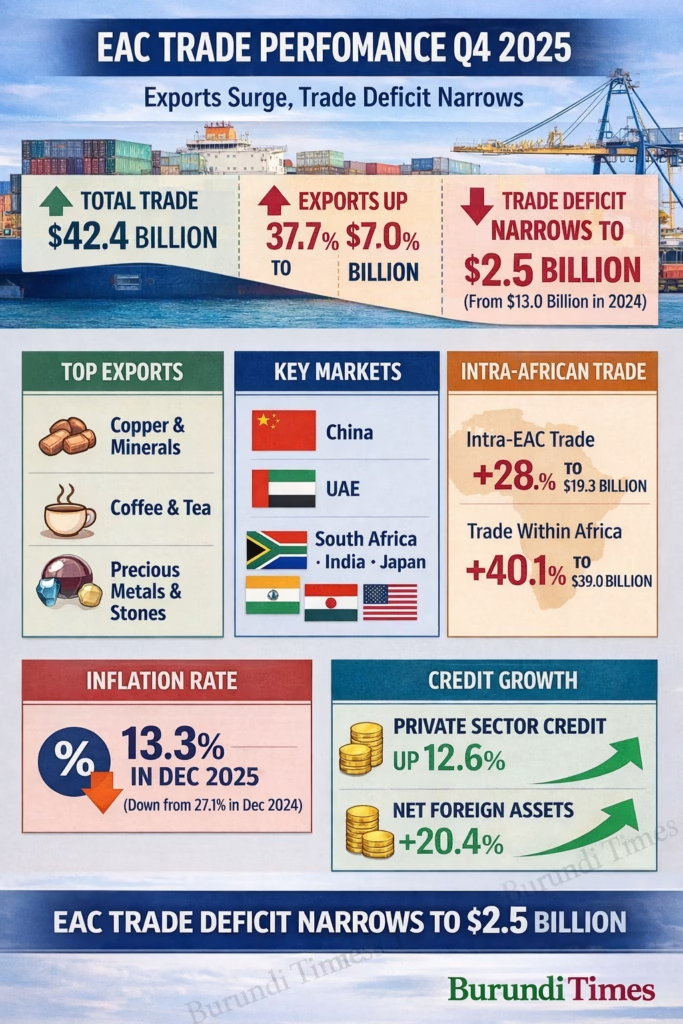
Total trade reached $42.4 billion during the October–December period, reflecting continued expansion across the region. Imports rose 15.4% to $79.6 billion, while exports surged 37.7% to $77.0 billion. As a result, the trade deficit narrowed sharply to $2.5 billion, down from $13.0 billion in 2024.
“The stronger growth in exports relative to imports underscores a favorable trajectory toward improved external balances,” the EAC Secretariat said in the bulletin.
Trade within Africa remained a key driver of growth, increasing 40.1% to $39.0 billion and accounting for 25.2% of total trade. Intra-EAC trade also expanded, rising 28.0% to $19.3 billion.
“This reflects continued progress in regional integration and trade facilitation, as well as the strengthening of the EAC’s trade ties within the African continent,” the report said.
Exports continued to be dominated by mineral commodities, particularly copper, alongside precious metals and stones. Agricultural exports, including coffee, tea and spices, also remained significant contributors. China retained its position as the region’s largest trading partner, followed by the United Arab Emirates, South Africa, India, Japan and the United States.
On the import side, energy products, machinery and manufactured goods supported industrial activity, infrastructure development and consumer demand across member states.
Overall, the EAC described the fourth-quarter trade performance as evidence of “a resilient and steadily improving regional economy,” citing export growth, a reduced trade deficit and expanding intra-African trade as key indicators of progress.
“The EAC Secretariat continues to prioritize the creation of an enabling trade and investment climate, the promotion of value addition, and the advancement of inclusive prosperity,” it said.
Inflation Moderates but Annual Average Rises
Inflationary pressures across the region eased toward the end of the year. Annual headline inflation stood at 13.3% in December 2025, down from 15.2% in November and significantly lower than 27.1% recorded in December 2024.
Despite the late-year moderation, the annual average inflation rate for 2025 rose to 22.9%, up from 13.6% in 2024. The increase was largely driven by elevated inflation in South Sudan and Burundi, which recorded rates of 114.7% and 34.8%, respectively.
Core inflation, which excludes food and energy prices, declined to 9.6% in December from 12.0% in November, compared with 30.0% a year earlier. Food inflation also eased to 18.5% from 23.8%, while energy, fuel and utilities inflation edged slightly higher to 9.5%.
Monetary Conditions Show Mixed Trends
Monetary developments across the region were broadly aligned in the fourth quarter, with most partner states recording declines in 91-day Treasury bill rates. Rwanda and Uganda were exceptions, posting increases of 100 and 20 basis points, respectively.
Lending rates declined in most countries, except South Sudan, while deposit rates generally increased. Interest rate spreads varied widely, with South Sudan recording the highest at 15.7% and Rwanda the lowest at 4.4%.
Growth in broad money supply slowed to 14.7% year-on-year, supported by a 12.6% increase in private sector credit. Net foreign assets rose 20.4%, signaling improved external positions.
The EAC said these trends point to “strengthening macroeconomic fundamentals” and continued recovery momentum heading into 2026.