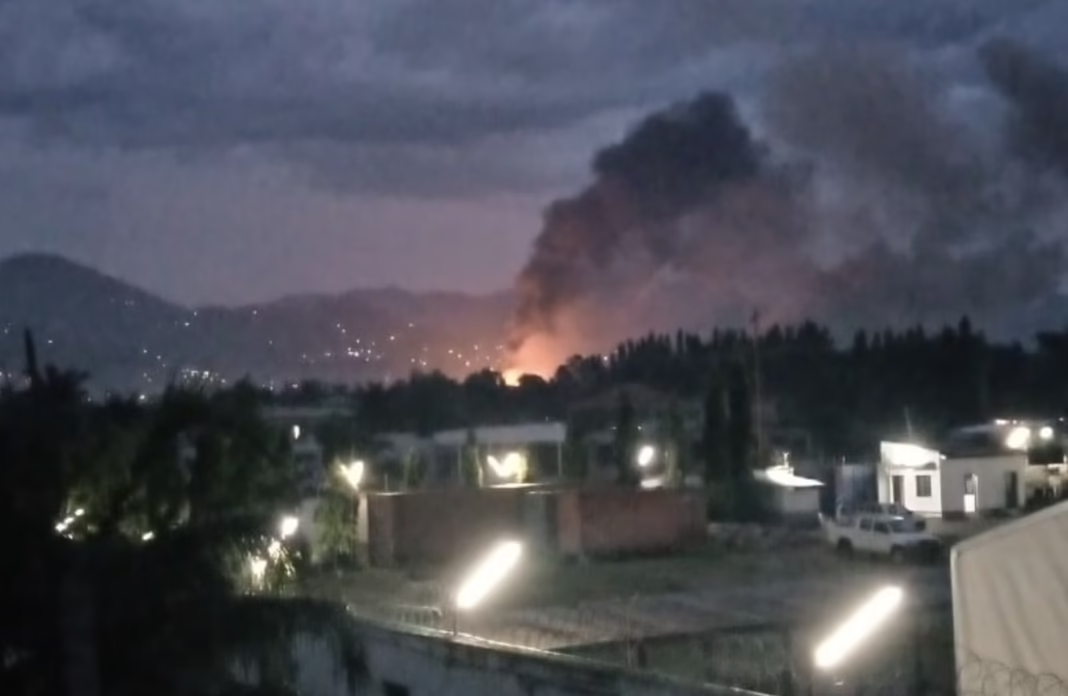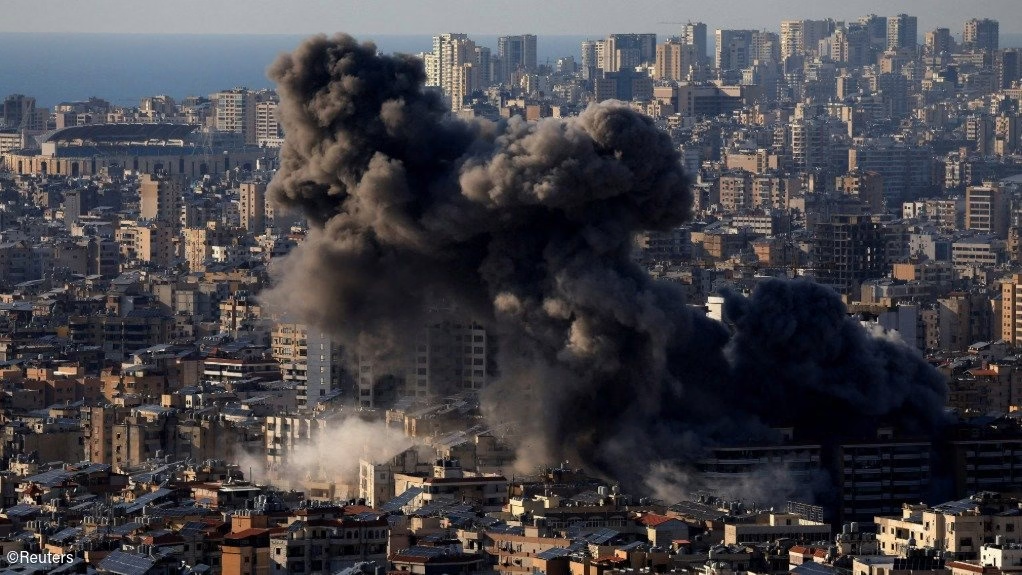

I write this opinion piece with a heavy heart. Two burdens weigh on me: a tragic incident that took lives, shattered families, and caused destruction in Bujumbura on March 31, 2026, and the alarming decline in reporting standards I witnessed across the Great Lakes region.
How It Unfolded
At around 6:30 p.m., an explosion ripped through downtown Bujumbura, Burundi’s economic capital. I had been waiting for a friend near the Chinese-owned T-2000 shopping complex. Minutes later, as I got into his car, we heard a deafening blast. Those on higher floors likely felt it more intensely.
People began fleeing from nearby multi-storey buildings. Panic spread instantly. We first assumed a gas explosion. We asked around, but no one spoke. Fear had sealed every mouth.
We drove off as the situation deteriorated. Hundreds ran in all directions. Cars defied traffic rules, horns blared, people shouted, and drivers mounted one-way streets. Chaos took over.
We stopped again. Someone pointed ahead, and we saw thick smoke rising in the distance. Then came more explosions, louder, closer, more violent.
The journalist in me thought, “This is a story.” The human in me replied, “These are terrified lives.” I was not there as a reporter. I do not practice in Burundi, for reasons informed readers know. I was there as a normal mwananchi simply in the wrong place at the wrong time.
What Was Really Happening?
I refreshed official military and security channel feeds. I called contacts. No response.
Minutes later, the first official statement appeared. Brigadier General Gaspard Baratuza, army spokesperson, confirmed on X that the explosions originated from a munitions depot at a military base in Bujumbura that had caught fire. The Ministry of the Interior echoed the message. It urged calm and warned against panic-driven accidents already unfolding across the city.
But official statements did little to contain the chaos.
Not everyone is on X. And many who are still carry the scars of Burundi’s 2015 failed coup attempt against the late President Pierre Nkurunziza. Those events triggered violence, mass displacement, and a brutal crackdown on the media. Journalists fled, and others lost their lives among them the state broadcaster’s veteran cameraman Christophe Nkezabahizi, who was murdered together with his wife, daughter, and son. Others were abducted, as was the case with Iwacu’s Jean Bigirimana in July 2016. Newsrooms burned. Lives we re lost. Those memories remain raw. Worse, a few decades before that, the post-1993 civil war hurt Burundians emotionally and physically. You can understand the depth of collective trauma.
A Human Reflex
What I witnessed during those few hours of explosions without a camera or recorder provoked deep reflection. I thought of innocent civilians dying elsewhere: Eastern Democratic Republic of Congo, Gaza, Iran, Israel, Southern Lebanon, Ukraine… Places where explosions are no longer anomalies but have become routine, where fear is ambient, where uncertainty is constant. The world deserves better priorities, better investments. Imagine if resources poured into war were redirected toward public welfare: fighting hunger, advancing science and technology, supporting journalism, and defending human rights. The return would be immeasurable.
Am I Asking Too Much?
There was a time when people turned to journalists for clarity in moments like this.
Yesterday, I had proximity to the scene and access to primary sources. I was not under deadline pressure. I observed. I verified. I read. And I was stunned.
I read reports that made me laugh. Others made me angry. I took screenshots. I called colleagues I trust. Questions flooded my mind. What I saw was not journalism. It was performance.
Perhaps we need to redefine the term. “Influencer” felt more accurate in many cases.
Credentials are not enough. A byline is not a shield. A large following is not proof of rigor.
Where were the hard questions? Where was verification? Where were OSINT and SOCMINT practices to debunk the flood of falsehoods?
Old videos resurfaced as “Breaking News.” Images were taken out of their original contexts. Speculation spread unchecked. We should have been guiding the public, mapping danger zones, identifying safe routes, and providing clarity — not amplifying confusion.
A Crisis Within a Crisis
As I tried to leave downtown, a former colleague abroad sent me screenshots from journalists’ posts — some of them from mutual contacts. He asked, “Is journalism dead?” I replied, “We’re in trouble.”
We switched to a video call for a few minutes so he could see what I was describing. It is not that he could not trust my word, but he is a field journalist. He has reported live from war zones, and I loved him for it. His insights in editorials are always valuable. He does not leave loose ends when working on a story. The conversation was brief, but its meaning was not. That question lingered. It echoed.
I was facing two crises at once: one unfolding in the streets, another within our profession.
The Questions We Failed to Ask
Journalism begins with questions — the right ones. The 5Ws, among others.
What caused the explosion? Why is a munitions depot located in a densely populated area? Is this consistent with safety standards? How old was the ammunition? What oversight mechanisms exist? What immediate guidance was given to civilians? How many casualties? Injuries? Missing persons? What is the scale of material damage? What support is the government providing? What measures is the country taking to prevent recurrence?
These are not radical questions. They are foundational. Instead, we chased speed, clout, visibility, and virality.
Journalists, Not Influencers
Journalism is not content creation. It is a public service. While influencers have freedom, journalists have obligations. We need verification before publication, multiple-source confirmation, context over immediacy, and accuracy over attention. Those chasing views may not have much to lose, but we do. Our deontology and ethics make that clear.
These are not optional standards. They define the profession. Nonpartisanship is not weakness — it is credibility. Taking sides in the name of patriotism is not journalism. It is advocacy and pure PR, and the distinction truly matters, especially in times of crisis in our communities.
Where the Real Fight Lies
Yes, journalism in the Great Lakes region faces systemic pressure. Since 2015, Burundi’s media landscape has endured severe repression. Independent outlets were attacked or shut down. Journalists were killed, jailed, or forced into exile. International broadcasters were banned.
Across the region, press freedom remains fragile. Reporters operate under political and financial constraints. Arrests of journalists are frequent, audiences are shifting, and traditional publishing models are changing.
In the sub-region, the most recent Reporters Without Borders (RSF) World Press Freedom Index indicated that journalists work “under intense political and financial constraints.” Reports show that in the past decade, at least 500 journalists were arrested in the region. According to the Paris-based non-governmental organisation, press freedom rankings are low in almost every country in the region: Tanzania ranks 95th out of 180, Kenya 102nd, Burundi 125th, DRC 133rd, Uganda 143rd, and Rwanda 146th.
These are real battles, but we are somehow choosing the wrong ones.
Declining professional standards should not be one of them. It only adds unnecessary pressure to a sector already facing significant threats in the region.
Rebuilding the Craft
We must revisit the classic fundamentals of journalism and adapt them where necessary.
In one of the international media gatherings I attended at the end of 2025, I kept hearing a valid question from colleagues, mostly from Francophone West Africa and the Sahel. I believe it would have been the same had Great Lakes region Francophone journalists been in attendance: “Why is so much attention shifting from Francophone to Anglophone Africa in terms of opportunity and support for local journalists?” I wish someone had a straightforward, one-sentence answer.
But some equally valid follow-up questions are even more practical here: How do we adapt media funding models? How do we integrate AI responsibly? How do we rebuild audience trust?
Journalism today is not just about producing content. It is about impact. Do we see it? Do we measure it accurately? It is about holding those in power accountable, countering misinformation and disinformation, exposing corruption and human trafficking, amplifying marginalized voices, and reporting crises with precision and humanity. This is the mandate.
Final Word
You may disagree with me — but that is the nature of opinion pieces.
One point, however, should be clear: in volatile contexts, misinformation kills.
Publishing unverified claims, even with conditional language, fuels panic. Claims of drone attacks, coups, mass casualties, or city-wide assaults spread faster than corrections and editors’ notes ever will. Once we hit the “publish” button, our content cannot be contained — it cannot be unseen.
Our voices carry weight. They can inform or inflame.
Yes, you may argue it is a social media platform and not a newsroom but people likely know you from the work you did in a traditional newsroom. The voice you have may have been amplified by the trust people place in your past or current media workplace. Your social media is not private. It is public service, just as journalism should be.
Our societies have endured enough trauma. Journalism should build bridges, not erode the little trust that remains between our peoples — from Rwanda to Burundi, from DRC to Uganda, and from Tanzania to Kenya.
Cédrick Irakoze is a Senior Editor and Translator with over seven years of experience in multilingual journalism and content localization. He specializes in English ↔ French translation, OSINT-based fact-checking, and information integrity.